Mobile Ad Eaters on misleading creatives, fake gameplay, and the real cost of deception in mobile game user acquisition.
“It reminds me of the practice of some soldiers in the wars of the last century who shot themselves in the foot to escape the front lines.” – Daniel Jiménez @ Tilting Point
“Fake gameplay works better because it’s 100% designed for marketing.” – Elena Lazuko @ Goodville
“In our case at Zynga, we avoid using misleading ads as the strength of our games is in the value we offer to the players when they play it.” – Javi Digiorgio @ Zynga
“Fake ads can work. But the ones that work long term are the ones that aren’t really lying.” – Polina Miakushko @ Snax Games
The Honesty Trade-Off
Few practices in mobile game user acquisition divide creative teams quite like fake mobile game ads.
The pitch is simple: invent a hook that drives clicks (the relevancy to the game doesn’t matter), attract installs you’d never win on real gameplay, and let the algorithm reward you for the high click-through rate (CTR) and curiosity of potential players.
The fallout, however, is less simple: bad-fit users, weak retention, brand erosion, and a player base that learns to distrust the medium. So, is it worth it? Or are UA teams shooting themselves in the foot for short-term gains?
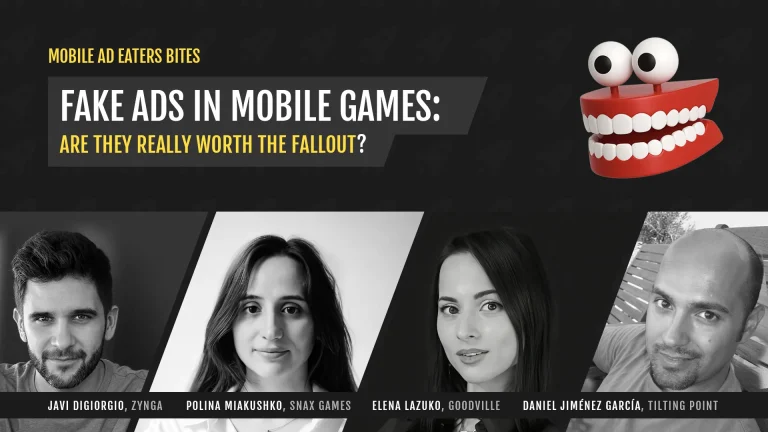
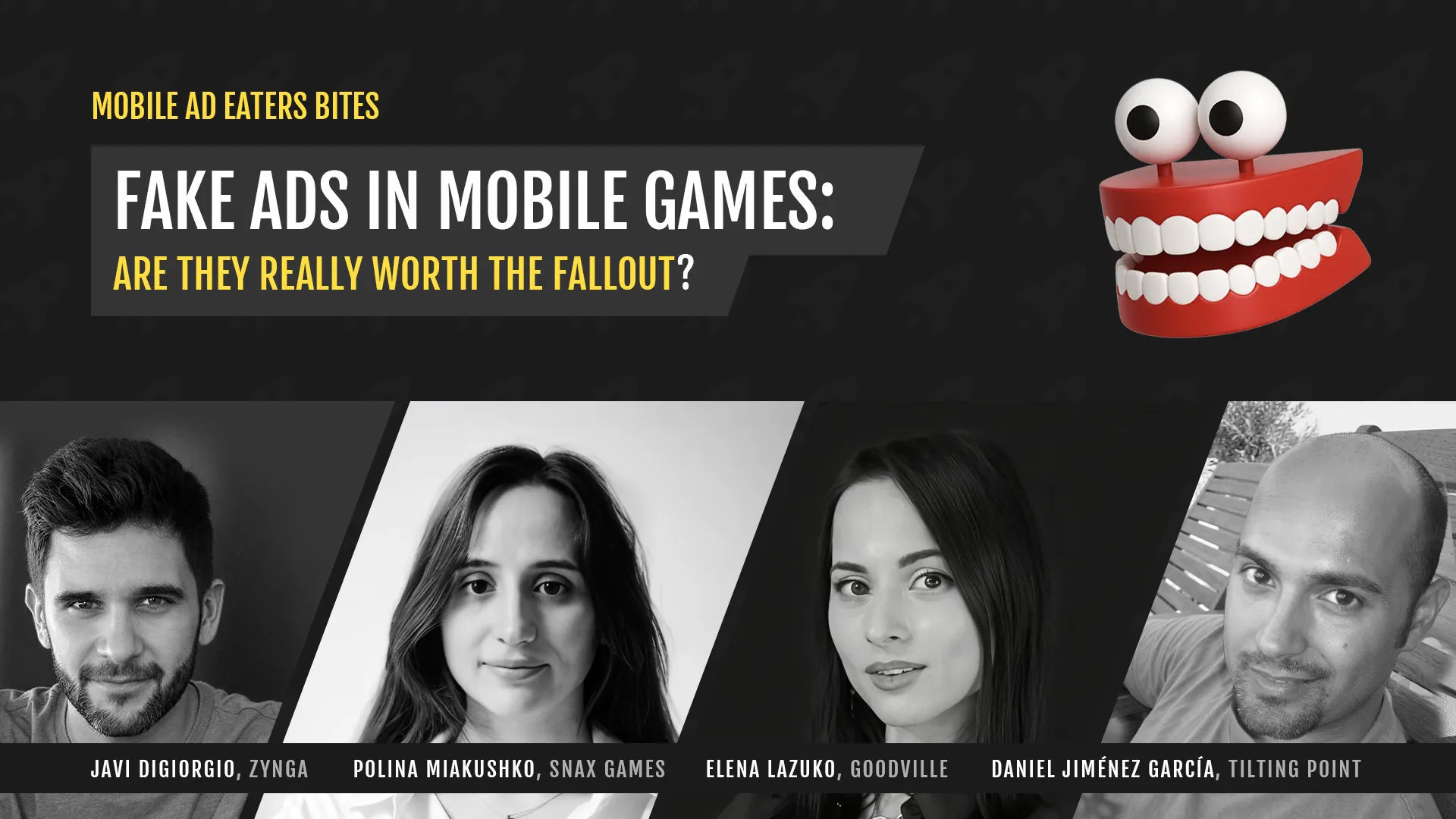
For this edition of Mobile Ad Eaters Bites, we asked creative leaders from Zynga, Tilting Point, Goodville, and Snax Games for their unfiltered take on fake gameplay ads, misleading creatives, and where the ethical and strategic line actually sits.
Verbatim responses below.



TL;DR
- Fake mobile game ads can improve CTR and install volume
- Misleading gameplay ads often hurts retention and player trust
- Most creative leaders prefer “enhanced reality” over complete deception
- The strongest-performing creatives usually exaggerate real mechanics instead of inventing fake gameplay entirely
Authenticity over misleading gameplay

In my view, every creative strategy must align closely with the game’s core brand and the specific environment in which it operates. For example, building an RPG requires emphasizing content depth, whereas a casual game demands a focus on accessible mechanics.
To be effective, it is essential to have a deep understanding of your genre, your target audience, and their specific motivations.
In our case at Zynga, we avoid using misleading ads, as the strength of our games lies in the value we offer to players when they play them.
When I see misleading ads in the market, I try to understand what the potential viewer is experiencing, why they might engage with that specific ad. Then, I take those learnings and apply them to our strategy, trying to replicate my hypothesis by showing our game’s strength. This has allowed us to connect with our players in a more significant way.
The long-term cost of fake gameplay ads

Posting an ad for a game that showcases completely different gameplay mechanics from the actual game is a common strategy in our industry. This may yield good results at first, but can prove disastrous in the long run.
It reminds me of the practice of some soldiers in the wars of the last century who shot themselves in the foot to escape the front lines. An act considered practically tantamount to desertion and therefore deserving of punishment. Some may have managed to escape the war, but more likely than not, they faced a court-martial. Similarly, the ad and the game will be subjected to the harsh judgment of the player who has fallen victim to this practice.
I believe that in the long run, this is undoubtedly a bad practice. You might get a good CTR, but conversion rates are usually very poor. It’s no mystery: the player is being deceived. You’re very likely attracting the wrong kind of player (a Match-3 enthusiast who ends up in a strategy game… What could go wrong?). In the long run, players sense that they’re being sold a pig in a poke, systematically underestimating them. Ultimately, it’s a huge lack of respect that, over time, only leads to a greater lack of trust in the industry.
As creatives, we are sometimes forced to resort to deception for various reasons. Perhaps that false-flag ad covers the month’s deliverables, or perhaps it’s proposed because we know that type of ad works well – surely the game managers know this too, and therefore it’s an easy idea to sell. Directly, its production will be requested, and the creatives won’t even have the option to consider the ethics of the action.
Personally, I don’t think anything goes. I’ve never seen a ‘TOP Performer’ ad based on the idea of showing something that isn’t actually true. It’s true that it’s useful for testing future mechanics not yet implemented, and for figuring out what kind of minigame works best, but beyond that, I’ve personally never seen it work well. Finally, in terms of production time, the investment in this type of ad is usually very high due to the customization it requires.
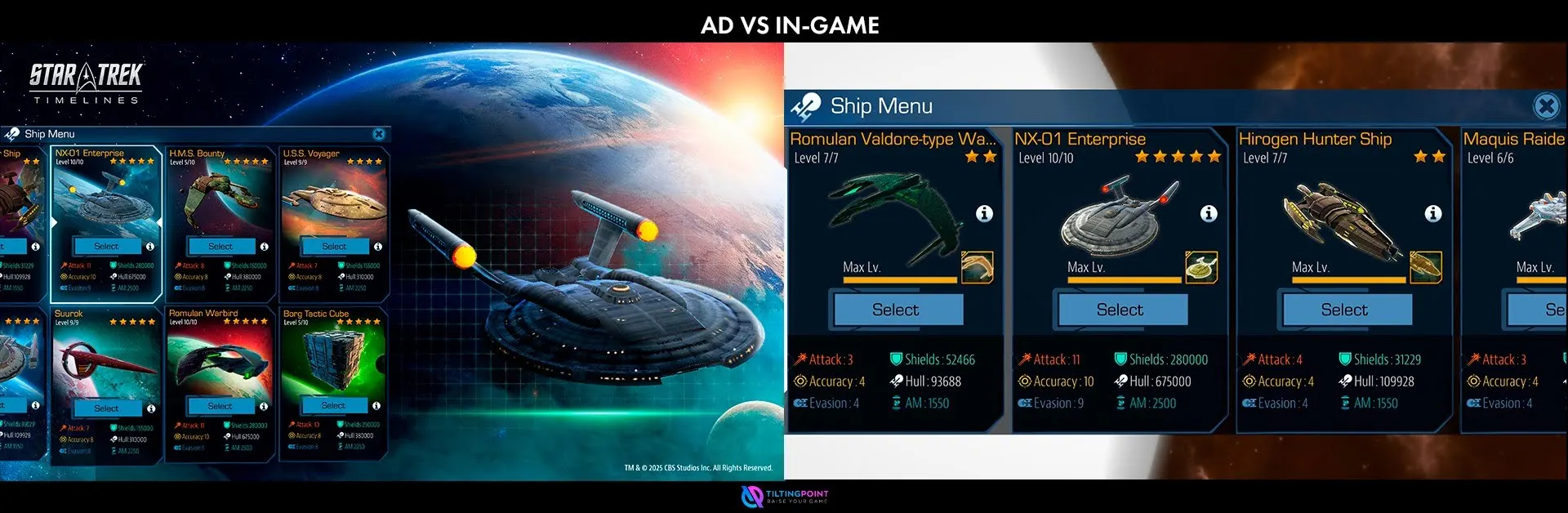
In my opinion, you get better results by sharing a good story, even if it doesn’t show exactly what the gameplay is like. A cinematic scene not found in the game but clearly showcasing the theme, or even fake-gameplay that, while a reconstruction, at least demonstrates the mechanics of the advertised game. Selling a real concept is much more acceptable; in some successful cases, a post-release update based on the ad is even decided upon (I’ve seen it with my own eyes, it happens!).
Why fake gameplay creatives attract clicks

Fake gameplay works better because it’s 100% designed for marketing. It packs the entire game experience and emotions into a short video that grabs attention instantly.
In the actual game, the gameplay is built to keep the player busy: there are many objects, tasks, and “background noise” to deal with. But in a video, we control the viewer’s attention second by second, focusing only on what’s important.
We mix the mechanics to give the viewer a hit of dopamine first, and then show an epic fail at the end. This makes them think: “I could do that better!” It’s much harder to trigger that kind of emotion with real gameplay. The key is to avoid “hard mislead.” If the video has nothing to do with the actual product, you might get a lot of installs, but people will leave after five minutes because they won’t find what was promised.
Our team’s experience shows that the best mechanics to use are the ones actually in the game. For example, we really do have big animals (cows and chickens), and players really do complete orders to earn coins. That’s why our current creative is performing so well.
Also, one of our main mechanics is clearing the location and building structures. In the game, it looks a bit different. But in these types of creatives below, we focus only on the core action and skip the extra steps and stages that take much longer in reality.
Can fake mobile game ads work without misleading players?

Fake ads have their use. Whether they’re worth it depends on your game and its monetization model, because what you’re really doing is paying for installs with your retention. In a market where retention is already under pressure and UA costs keep going up, that is something to consider.
I prefer a hybrid approach, combining what users react to in a fake creative with real or enhanced gameplay. At a previous studio we looked at where our best players were coming from and adjusted our creatives to echo familiar moments from those games. Not fake gameplay, just a signal that said ‘if you liked that, you’ll like this.’ It worked.
Fake ads still make sense when volume is the priority, budget isn’t a constraint, and LTV matters less.
Fake ads can work. But the ones that work long term are the ones that aren’t really lying.
Want to keep the conversation going?
Mobile Ad Eaters Retreat 2027 is returning to Prague next spring — a creative-focused event for CMOs, UA Leads, Creative Producers, and Creative Strategists in mobile gaming.
In 2026, we brought together 150 of mobile gaming’s top creative minds for a new kind of event built on connection. For 2027, we’ll double down on connecting people together and deep knowledge share. Register your interest already now as this event will be sold out fast!
Register your interest early — this event is expected to sell out fast.
 Want to hear more?
 Talk to 150 creative minds in person