
Mobile gaming is one of the world’s most competitive industries. How to scale mobile games profitably is one of the biggest challenges in today’s competitive mobile gaming industry. To scale profitably, you need more than a great product; you need a plan centered on one critical equation: LTV (Lifetime Value) > CPI (Cost Per Install). In simple terms, the revenue from each player must exceed the cost of acquiring them.
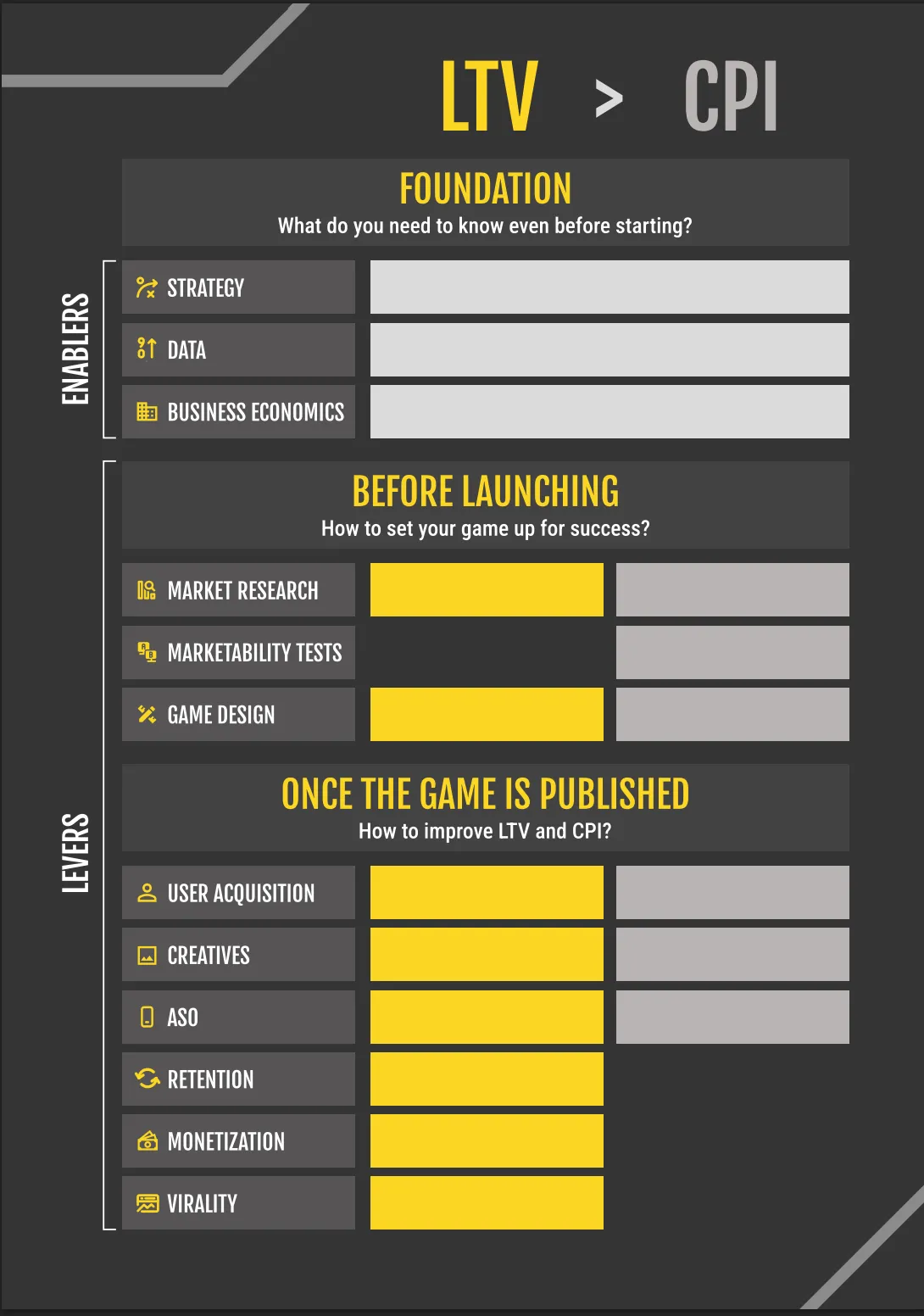
This article – the first in a series adapted from our LTV>CPI Playbook – breaks down the three Foundational Enablers required to win.
1. How Strategy Helps You Scale Mobile Games Profitably
The market demands a strategic focus on the LTV > CPI balance from day zero. This is the foundation of how to scale mobile games profitably in a sustainable way. Two principles can set you up for success:
Principle one = “It’s a Marathon, Think Ahead.”
You must develop a strong competitive advantage before your game even goes live. Below you can find 3 suggested ways to do it:
- Competitive advantage in CPI: Use market research to find themes that lower acquisition costs. For example, Project Makeover (one of the top-grossing titles in the puzzle category) achieved a massive scale of 100M+ downloads after translating its user behaviour analysis into “soap-opera” style ads that grabbed attention and drove down acquisition costs.

- Competitive advantage in LTV: Move toward “hybrid” monetization by layering meta-mechanics over core gameplay to boost retention and In-App Purchase (IAP) activation.
- Competitive advantage at the company level: Strategic specialization in a single genre enables reusable code and faster feature implementation. Studios like FunCraft manage massive portfolios with relatively small teams by using cross-promotion to boost engagement and retention across their entire ecosystem.
Principle Two: “You Control LTV More Than CPI.”
While CPI is largely market-driven, LTV is shaped by your team’s decisions. Focus on Game Design, Retention, and Monetization to fix your “leaky bucket” before you try to scale.
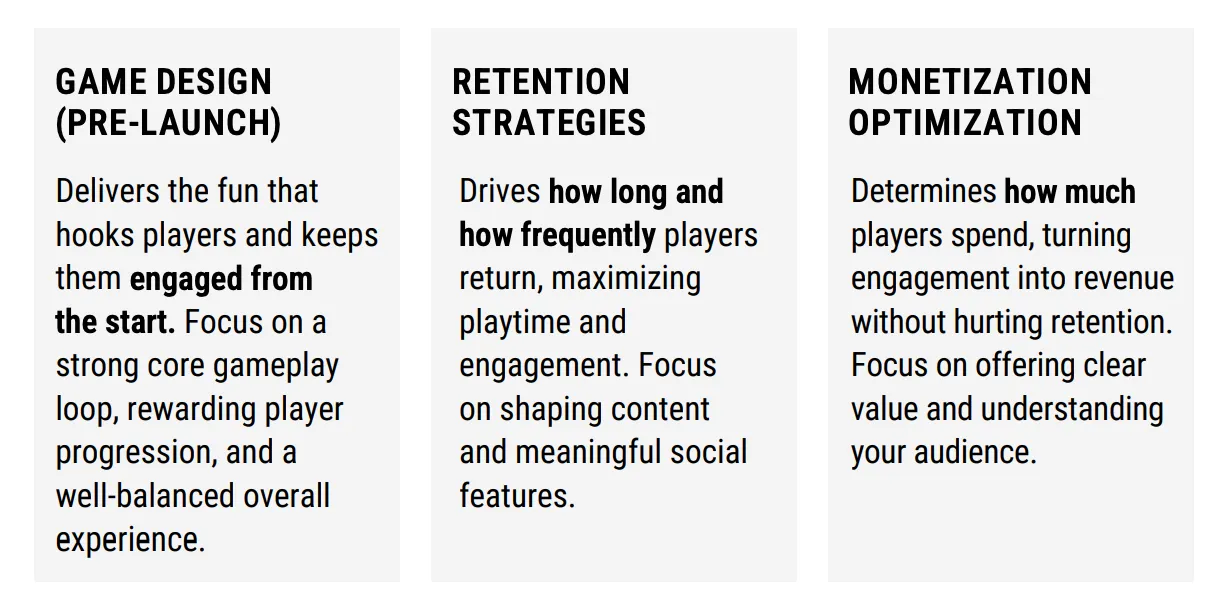
If your game isn’t fun or suffers from poor retention, it’s a leaky bucket. No amount of expensive paid acquisition will result in a positive ROAS if the fundamentals aren’t fixed first!
2. Using Data to Scale Mobile Games Profitably
To balance the scales, you must understand how LTV and CPI interact correctly.
First Advice: “Set the right UA Budget vs. Margin.”
It is not enough for LTV to exceed CPI; it must be high enough to support scalable, profitable user acquisition. As you scale spending, CPI typically rises, and LTV may decrease as you reach lower-value users.
The key is understanding that higher ROAS reduces financial risk:
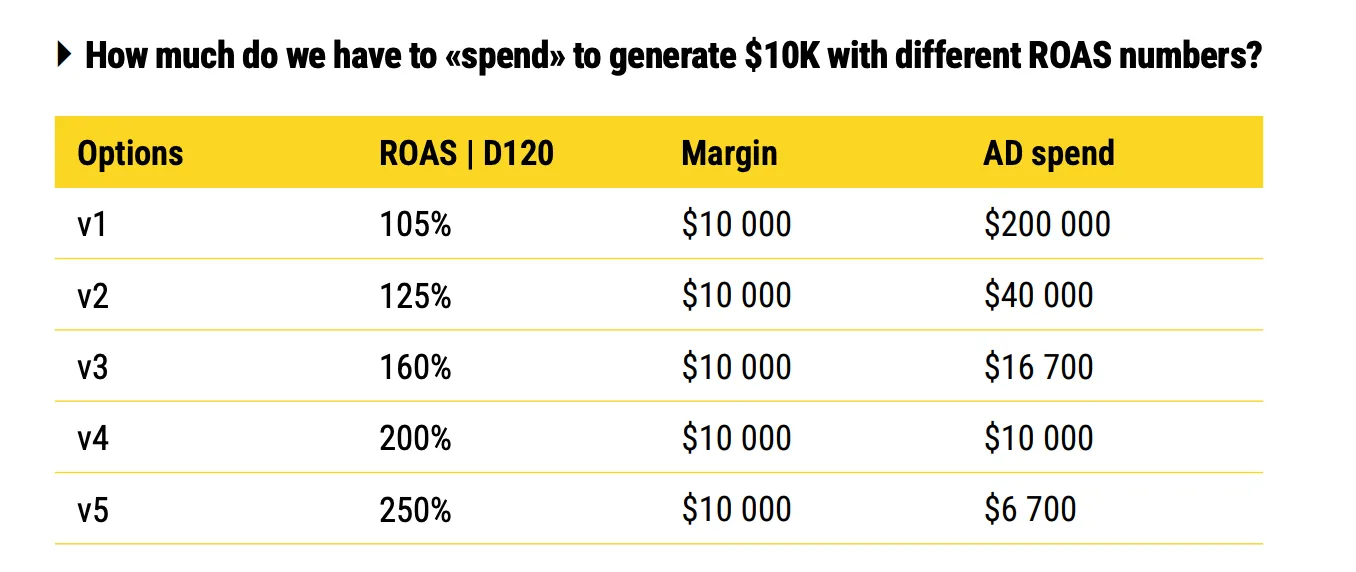
- Tight Margins (105% ROAS): You must spend $200,000 to net a $10,000 margin.
- Healthy Margins (125% ROAS): You only need to spend $40,000 to reach that same $10,000 profit.
Simply put, higher ROAS increases your capacity to generate profit while keeping acquisition costs sustainable. Optimize your budget for margin, not just volume. Paid UA must be self-sustaining – it should “foot the bill” on its own without relying on diminishing organic growth.
Second Advice: “Visualize and Predict LTV Over Time.”
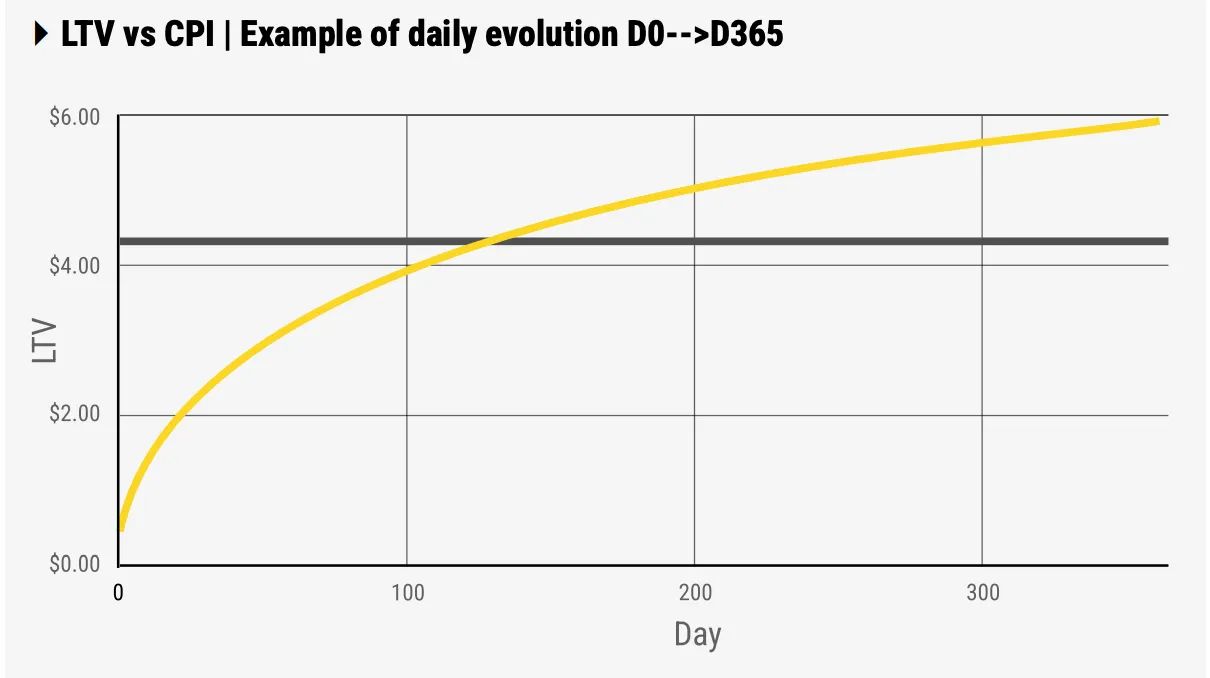
LTV is a function of time; always specify “LTV at Day X”.
For example, in the early days of a cohort (Day 1), you can see your CPI clearly, but you won’t have a reliable LTV estimate. Use LTV Prediction as a tool to spot trends early and spend with confidence.
- Own Your Data: MMPs often restrict long-term data access; storing data in your own database is the best solution for deep analysis.
- Monitor CPI Components: Break down costs into CPM (market demand) and IPM (creative performance) to determine if cost changes are market-driven or performance-driven.
If you’re interested in how to approach LTV predictions, check out this article.
Third Advice: “Get a Multidimensional View of LTV.”
Analyze how LTV varies across platforms, geographies, media sources, and device types. By adopting this multidimensional approach, you can make smarter budget decisions and improve both monetization and UA efficiency. High-end device owners typically have greater spending capacity, which directly translates into higher LTV.
3. Business Economics Behind Scaling Mobile Games Profitably
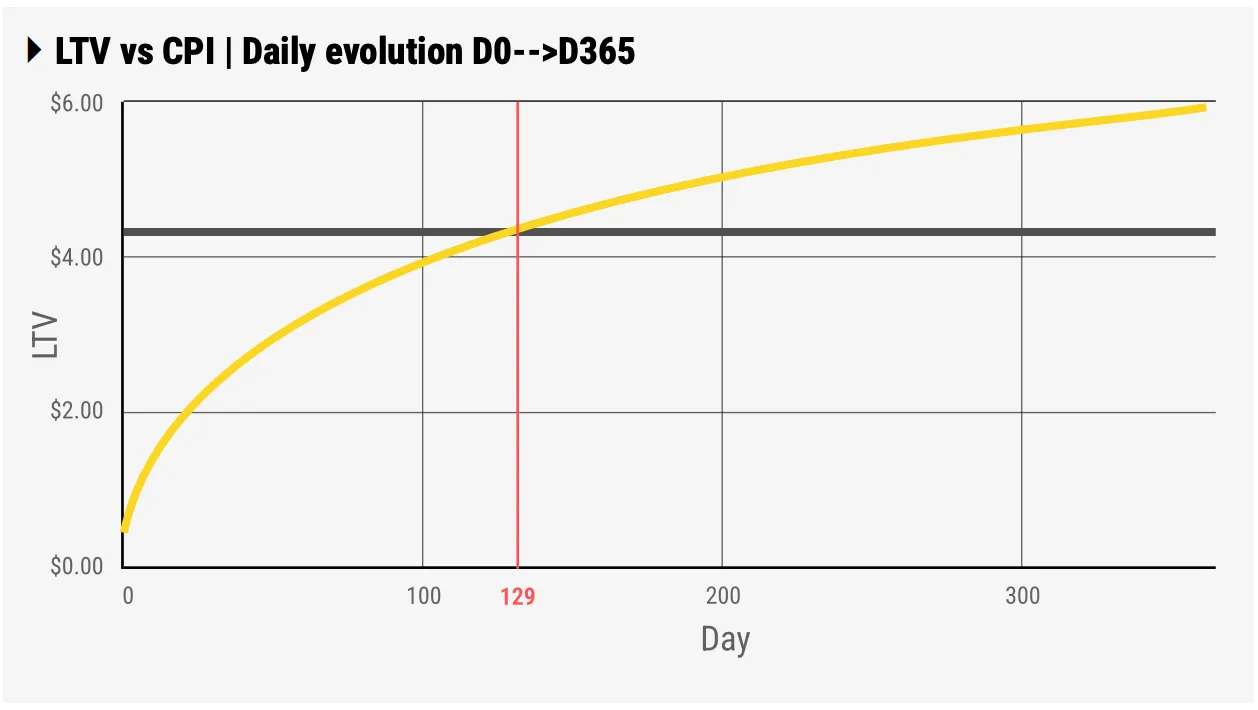
Reaching payback is one milestone, but reaching it faster is the real goal. The steeper your LTV curve, the healthier your cash flow and the more capital you have available for UA reinvestment. Here are the critical points to consider:
- Payback Time: The first day LTV equals or exceeds CPI is your break-even point. Shorter payback periods (2–7 days for Hyper-casual) allow for rapid reinvestment, while longer periods (up to 2 years for Hardcore) increase financial risk.
- Shape of the Curve: A steeper LTV curve means healthier cash flow. Focus on early monetization – on iOS, 25% of buyers make their first purchase by Day 2.
- Avoiding Pitfalls: Studios often fail due to mismanaged financial planning, such as ignoring payback dynamics, underestimating margin needs, or setting unrealistic UA budgets.
In this example, the payback time is reached at Day 129.
Conclusion (Mastering the Marathon)
Scaling a mobile game is a marathon that requires more than just talent; it requires a structured, data-driven plan to ensure your game is a sustainable business and to truly understand how to scale mobile games profitably over time. By mastering these foundational enablers (Strategy, Data, and Business Economics) you move beyond guesswork and build a self-sustaining growth engine.
For a deeper dive into the whole framework, you can download the LTV > CPI Framework Diagram as a strategic checklist for your game’s lifecycle here.
Next Up: We move from the foundation to Section 2: Before Launching the Game, where we explore how to validate your concept with marketability tests.