This guide focuses specifically on paid user acquisition management costs. For the broader studio mobile game marketing budget, including ASO, creative production, tooling, and full growth infrastructure, see our mobile game marketing agency pricing guide.
For store visibility, conversion optimization, metadata, screenshots, and product page testing costs, see our app store optimization pricing guide.
Finding the right mobile user acquisition agency shouldn’t feel harder than scaling the app itself. Yet for many mobile app marketers, growth leads, and studio CMOs, evaluating agency pricing quickly turns into a maze of vague retainers, hidden fees, confusing performance promises, and wildly different proposals that are almost impossible to compare.
One agency charges $5,000 per month. Another quotes 15% of ad spend. A third promises “performance-based pricing” without explaining how attribution actually works. Meanwhile, average mobile user acquisition cost benchmarks continue rising, and platforms like Meta, TikTok, Google, and Applovin demand increasingly specialized execution.
The reality is that user acquisition agency pricing is rarely just about the fee itself. It reflects strategy depth, creative production requirements, attribution complexity, testing velocity, reporting sophistication, and the actual experience level of the team managing your campaigns.
This guide breaks down the four most common user acquisition agency pricing models, explains what drives mobile user acquisition costs in 2026, and shows how to evaluate whether an acquisition agency is actually worth the investment.
What Is User Acquisition Agency Pricing?
User acquisition agency pricing is the fee structure a mobile app marketing agency uses to charge for managing paid acquisition campaigns. It is typically structured as a monthly retainer, a percentage of ad spend, a value / performance-based fee, or a hybrid pricing model.
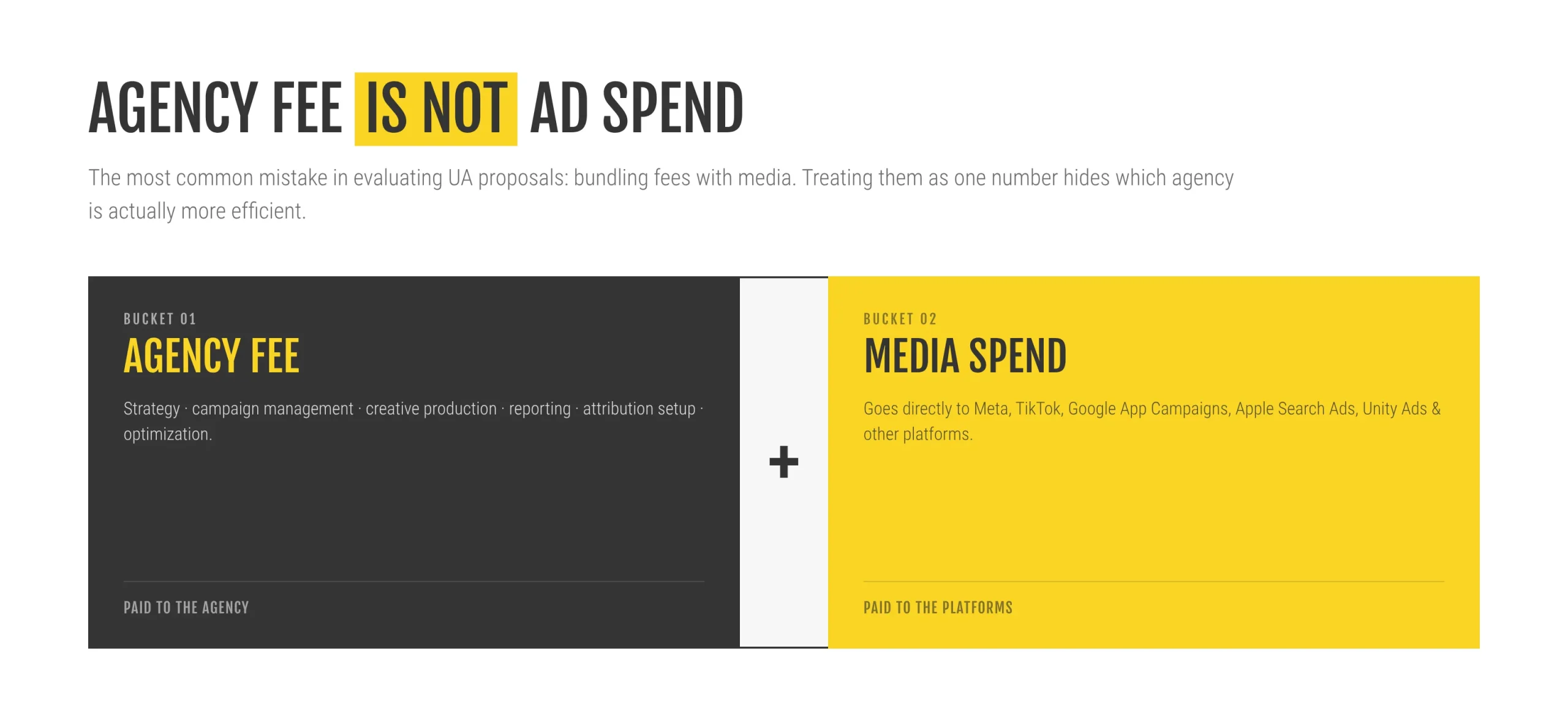
The agency fee is separate from media spend. The pricing covers services like campaign strategy, account management, creative production, reporting, attribution setup, and campaign optimization, while the advertising budget itself goes directly to platforms like Meta, TikTok, Google, and Apple Search Ads.
This distinction matters because one of the most common mistakes app marketers make is comparing proposals without separating agency fees from actual ad spend (or not communicating their budget clearly to the agency). A cheaper agency fee does not automatically mean lower customer acquisition cost or overall better campaign performance.
Why User Acquisition Agency Pricing Is Hard to Compare
Two user acquisition agencies can quote completely different pricing for what appears to be the same scope because “mobile user acquisition” can mean very different things depending on the agency. Some proposals only include campaign management. Others bundle creative production, MMP setup, incrementality testing, app store optimization support, and custom reporting into the fee. Platform coverage also changes pricing dramatically — managing Meta alone is fundamentally different from running coordinated campaigns across TikTok, Google Ads, Apple Search Ads, Unity Ads, and influencer channels simultaneously.
App category complexity matters too. Gaming apps, finance apps, subscription-based mobile applications, and dating platforms all operate under different acquisition economics, retention curves, and creative demands. Geographic expansion, localization requirements, attribution complexity, and creative testing velocity also heavily influence operational scope. And perhaps most importantly, “user acquisition agency” can describe anything from a two-person freelancer operation to a 100-person mobile growth company with dedicated strategists, analysts, designers, and product specialists.
The lack of transparent pricing benchmarks benefits agencies more than clients. That’s why the rest of this guide focuses on translating vague proposals into apples-to-apples comparisons that actually reflect campaign complexity, acquisition strategy requirements, and expected business outcomes.
The Four Pricing Models Used by Mobile User Acquisition Agencies
Every mobile UA agency proposal ultimately comes down to one of four pricing structures — and each model creates different incentives between the agency and the client.
1. Monthly Retainer
The monthly retainer remains the most common pricing structure in mobile app marketing services. Under this model, the client pays a fixed monthly fee in exchange for a defined scope of work that usually includes campaign management, reporting, strategy support, optimization, and a baseline level of creative production.
Typical retainers range from roughly $3,000 to $25,000 per month depending on campaign complexity, number of channels managed, geographic scope, and creative requirements.
The biggest advantage of a retainer model is predictability. Finance teams can forecast marketing expenses more accurately, and app marketers know exactly what they are paying each month regardless of media spend fluctuations.
The downside is incentive alignment. The agency earns the same amount whether campaign performance improves dramatically or stagnates. That doesn’t mean retainers are bad — many excellent app marketing agencies operate on this structure — but it does mean clients should negotiate clear KPIs, reporting cadences, optimization expectations, and creative deliverables upfront.
It’s also vital to define clear goals such as “ROAS on day X” to avoid unprofitable spend and force the agency to reallocate budget to better performing campaigns.
A strong retainer agreement should define what success actually looks like: be it above-mentioned ROAS targets, payback windows, CPI benchmarks, retention metrics, or subscription conversion goals.
2. Percentage of Ad Spend
Under this model, the acquisition agency charges a percentage of monthly media spend, typically between 5% and 15%, usually depending on type of channels and budget size (higher budget = lower %). At $50,000 monthly ad spend, that translates into roughly $7,500 in agency fees at a 15% rate. At $500,000 monthly spend, the same structure becomes usually somewhere around $25,000 per month.
The appeal is simplicity. Agency pricing scales alongside campaign scale, which feels intuitive for many app developers and growth teams.
But there’s an obvious incentive problem: percentage-based pricing rewards agencies for spending more money, not necessarily spending more efficiently. Higher spend does not automatically mean better campaign optimization, stronger retention, or improved monetization.
Also, even profitable campaigns at higher levels of spend might mean a tight margin and increased risk for the advertiser in case the predictive models or market changes.
That’s why experienced app marketers often negotiate efficiency safeguards into percentage-based agreements. These can include declining fee percentages at higher spend tiers, ROAS-linked bonus structures, capped fees, or hybrid models that combine retainers with performance incentives.
In mature accounts spending well above $250K monthly, flat-fee or capped structures become increasingly common because pure spend-based pricing quickly becomes difficult to justify operationally.
3. Performance-Based Pricing
Performance-based pricing ties agency compensation directly to measurable outcomes like cost per install, cost per registration, cost per paying user, or revenue share.
On paper, this sounds ideal for clients. The agency only earns when performance improves.
In practice, pure performance-based pricing is relatively rare in full-service mobile user acquisition. Agencies still carry fixed operational costs regardless of short-term campaign volatility: strategists, analysts, designers, reporting infrastructure, and creative production all cost money whether campaigns outperform or underperform.
Where performance pricing works best is in affiliate-driven acquisition, influencer marketing, CPA-based campaigns, or as an additional incentive layer on top of a stable base retainer.
Clients should also approach “performance pricing” carefully because some agencies compensate for risk using aggressive media markups or attribution manipulation. Always clarify exactly how installs, conversions, retention events, and revenue attribution are measured and verified.
4. Hybrid Pricing Models
Hybrid pricing has increasingly become the dominant structure for sophisticated mobile growth engagements in 2026.
A hybrid model usually combines a predictable base retainer often between $3,000 and $8,000 monthly with performance bonuses tied to specific business outcomes such as ROAS thresholds, CPI targets, install milestones, retention benchmarks, or revenue growth.
This structure works because it balances operational stability with genuine performance alignment. The agency has enough predictable income to support experienced talent, creative infrastructure, and strategic planning, while the client gains confidence that incentives are connected to actual business performance.
The quality of the contract matters more than the pricing structure itself. Vague performance bonuses tied to undefined “growth targets” create more confusion than alignment. Strong hybrid agreements define attribution methodology, reporting cadence, payback windows, and measurable success metrics from day one.
Mobile User Acquisition Cost Benchmarks Every App Marketer Should Know
Agency pricing only makes sense relative to actual media costs and mobile user acquisition costs have changed dramatically over the past several years. Average mobile app CPI has risen roughly 60% since 2020 because of increased demand for apps during Covid lockdown. On iOS, average CPI now sits around $4.70, while Android averages closer to $3.40. The historical gap between platforms has narrowed as privacy changes force advertisers toward broader targeting models, and more spend on Android where tracking is easier.
Regional benchmarks vary even more dramatically. North America remains one of the most expensive acquisition markets at roughly $5.28 CPI, while EMEA averages around $1.03, APAC approximately $0.93, and LATAM roughly $0.34. These differences fundamentally affect both campaign structure and agency workload. But keep in mind these are generic averages across categories and CPI for a casino game will be easily 50x compared to hyper casual title so look only at relative differences.
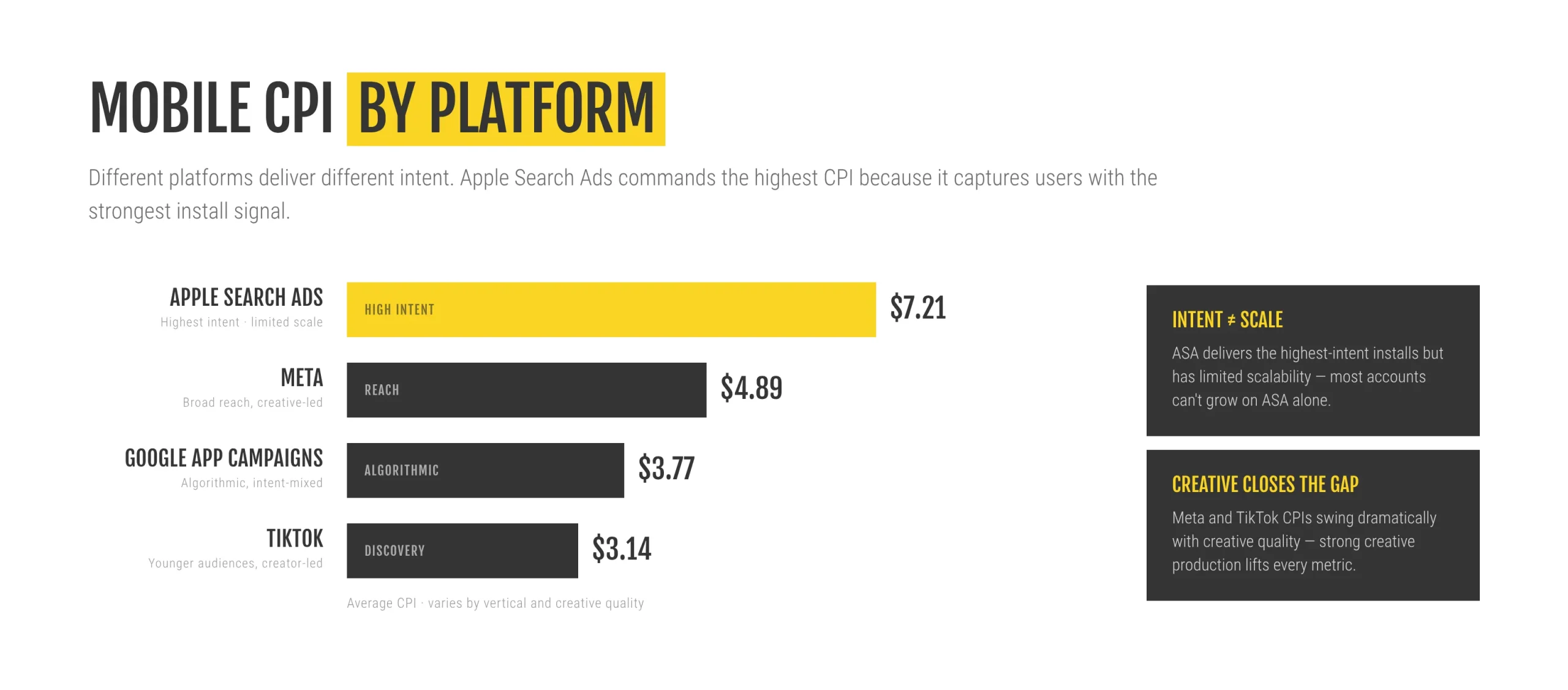
Platform economics matter too. Apple Search Ads often delivers the highest-intent users but also commands some of the highest CPIs at around $7.21 with very limited scalability. Meta averages roughly $4.89 CPI, Google Ads around $3.77, and TikTok approximately $3.14 depending on vertical and creative quality.
Vertical-specific benchmarks are even more important. Gaming apps average around $4.83 CPI, subscription apps approximately $7.89, dating apps above $8, and finance apps can exceed $15 due to exceptionally high LTV potential.
Higher-LTV mobile applications typically require more advanced attribution modeling, retention analysis, creative testing frameworks, and monetization optimization. Similarly, managing campaigns across multiple acquisition channels like AppLovin, Unity Ads, Mintegral, TikTok, and Meta, dramatically increases operational scope compared to running a single-platform setup.
What You Get at Each UA Management Budget Tier
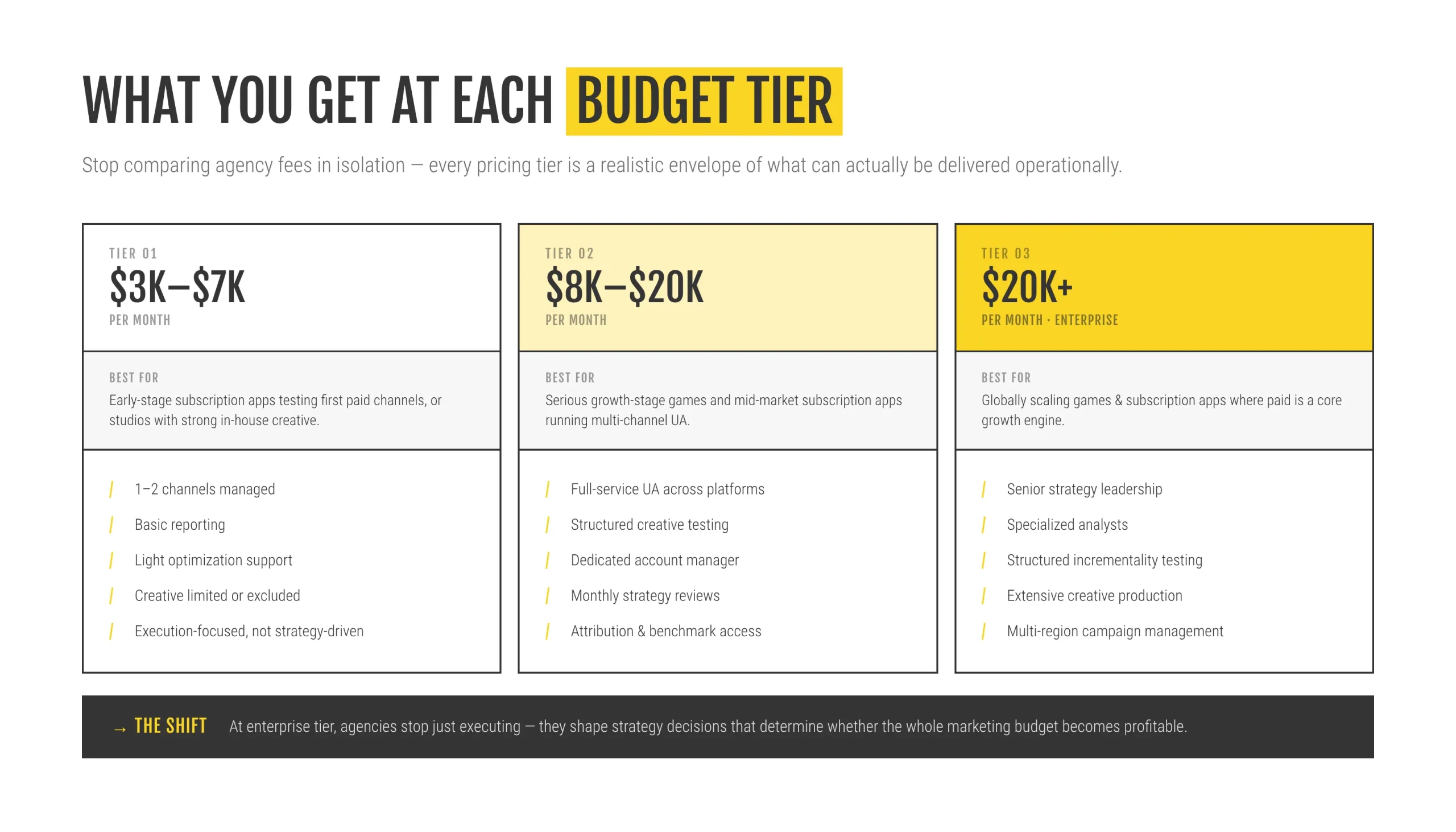
Most user acquisition agency pricing discussions become much easier once you stop thinking in terms of agency fees alone and start thinking in operational tiers. Every pricing tier represents a realistic envelope of what can actually be delivered operationally.
$3,000 – $7,000 per Month
At this level, clients usually receive account management for one or two acquisition channels, basic reporting, and light optimization support. Creative production is typically limited or excluded entirely.
This pricing tier works best for early-stage subscription apps testing their first paid acquisition channels or gaming studios with strong in-house creative teams that primarily need media buying support which is generally rare these days.
The important reality: this tier is execution-focused, not strategy-driven.
$8,000 – $20,000 per Month
This is where most serious growth-stage mobile games and mid-market subscription apps operate.
At this level, agencies usually provide full-service user acquisition management across multiple platforms, structured creative testing, dedicated account management, monthly strategy reviews, attribution support, and access to internal benchmarks or optimization frameworks.
Creative production is often partially included, but app marketers should always clarify asset volume, video scope, iteration frequency, and format coverage before signing.
$20,000+ per Month
At the enterprise level, clients gain access to senior strategy leadership, specialized analysts, structured incrementality testing, extensive creative production pipelines, multi-region campaign management, and deeper attribution infrastructure.
This tier suits globally scaling games, subscription apps with aggressive growth targets, and companies where paid acquisition represents a core growth engine.
At this level, agencies are not simply executing campaigns — they are shaping strategic decisions that directly influence whether the overall marketing budget becomes profitable.
How to Evaluate Whether an Acquisition Agency Is Worth the Cost
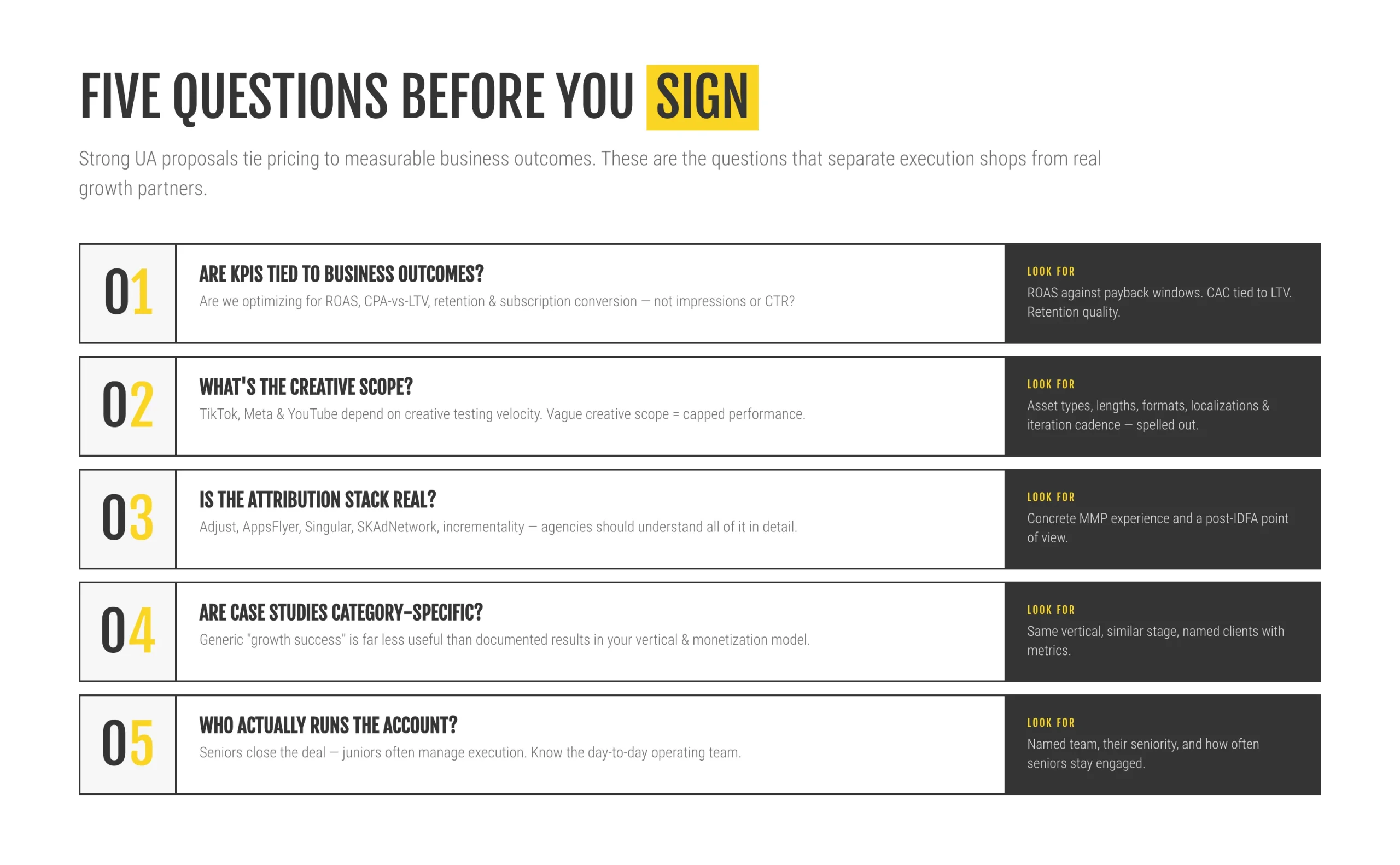
Before signing any acquisition agency agreement, app marketers should evaluate whether pricing is actually connected to measurable business outcomes. Strong proposals focus on metrics like ROAS against target payback windows, CPA tied to LTV benchmarks, retention quality, or subscription conversion rates — not vanity metrics like impressions or CTR alone.
Creative scope is equally important. Platforms like TikTok, Meta, and YouTube increasingly depend on creative testing velocity. If a proposal is vague about creative deliverables (type, length, formats, localizations), variations, and iteration cadence, performance limitations are almost inevitable.
The attribution stack also matters. A serious mobile user acquisition agency should understand Adjust, AppsFlyer, Singular, SKAdNetwork modeling, incrementality frameworks, and post-IDFA attribution challenges in detail. Weak attribution infrastructure often leads to poor optimization decisions regardless of media buying quality.
Case studies should be category-specific whenever possible. Generic “growth success” claims are far less valuable than documented results within your vertical, monetization model, or growth stage.
And finally, ask who will actually run the account day to day. Senior strategists frequently participate in sales conversations while junior teams manage execution afterward. Understanding the real operating team often tells you more about future campaign performance than the proposal itself.
The cheapest acquisition agency is rarely the best value. But the most expensive proposal is not automatically the smartest investment either. The right pricing structure is the one tied to outcomes you can independently verify.
What Strong Mobile User Acquisition Results Actually Look Like
User acquisition agency pricing only matters if it translates into measurable business performance. The right mobile UA partner should improve campaign efficiency, creative testing velocity, attribution confidence, retention quality, and long-term revenue growth – not simply increase install volume.
Strong acquisition strategy connects media buying, creative performance, store conversion, monetization signals, and LTV-informed decision-making. That is especially important for mobile games, where scaling spend too early can quickly expose weak retention, poor monetization, or creative fatigue.
DreamLoft – Scaling Paid User Acquisition Profitably for More Than 3 Years
AppAgent helped DreamLoft scale paid acquisition for Game of Words through a long-term growth strategy focused on sustainable profitability rather than short-term install spikes.
Within four months, the title achieved a 65% revenue surge supported by structured acquisition optimization and an expanded channel mix. AppAgent also developed a systematic creative testing framework that produced a 33% creative win rate, helping the team continuously identify scalable ad concepts rather than relying on isolated creative hits.

The engagement focused heavily on campaign efficiency, retention quality, LTV-informed acquisition strategy, and creative testing velocity – all critical factors in maintaining profitable scale over multiple years.
Marvel Puzzle Quest – Diagnosing Growth Opportunities Before Scaling Spend
Before aggressively increasing media spend, AppAgent used its GamePlan™ framework to evaluate the full acquisition and monetization system behind Marvel Puzzle Quest.
The diagnostic surfaced 79 distinct growth opportunities, developed 5 creative directions, and identified 6 app store conversion-rate hypotheses before additional acquisition budget was deployed.
This type of structured analysis helps app marketers avoid one of the most common scaling mistakes in mobile user acquisition: increasing spend before foundational monetization, onboarding, retention, attribution, or store conversion problems are understood.
Red Flags in User Acquisition Agency Pricing Proposals
Not every low quote is a bargain, and not every expensive proposal reflects strategic quality.
One of the biggest warning signs is vague language like “data-driven approach” or “full-funnel strategy” without a clear explanation of how the agency will improve campaign efficiency, creative testing, channel mix, reporting, attribution, or ROAS.
Long-term lock-in clauses are another concern. Strong agencies retain clients through performance and trust, not contractual penalties. Agreements with long cancellation windows or rigid scopes without meaningful review points deserve closer inspection.
Performance bonuses also need explicit measurement methodology. “We earn more when performance improves” sounds attractive until nobody can clearly define how attribution, ROAS, payback windows, conversion quality, or revenue impact will be verified.
Finally, be cautious around agencies that promise guaranteed installs or unusually low CPI before reviewing your game, category, markets, monetization model, and historical campaign data. In mobile UA, cheap installs rarely matter if they do not retain, monetize, or contribute to profitable growth.
Plan Your Mobile User Acquisition Budget with AppAgent
AppAgent is a strategic growth partner for mobile gaming studios.
We help teams understand where paid acquisition can scale profitably, where budget is being wasted, and which parts of the growth system need to improve before more spend makes sense.
Our principle is simple: strategy before scale.
Every engagement starts with GamePlan™ — a strategic diagnostic that maps opportunities across user acquisition, creative, ASO, onboarding, monetization, product experience, and data quality before major budget commitments are made.
The Growth Program then turns prioritized opportunities into structured 3-month execution sprints. For UA, that can include media planning, channel management, campaign optimization, creative testing, attribution analysis, reporting, and ongoing performance reviews.
This structure matters because profitable acquisition is rarely solved by media buying alone. A campaign may fail because of weak creative, poor store conversion, incomplete attribution, unclear LTV signals, or monetization issues after install.
For DreamLoft’s Game of Words, AppAgent helped drive a 65% revenue surge in four months and sustained profitable paid UA performance for more than three years.
For Marvel Puzzle Quest, GamePlan™ surfaced 79 growth opportunities before additional acquisition budget was deployed.
If you want clarity before scaling spend, let’s talk.
Frequently Asked Questions About User Acquisition Agency Pricing
User acquisition agency pricing usually depends on campaign complexity, monthly media spend, number of channels, target markets, creative testing needs, reporting requirements, attribution setup, and the seniority of the team managing the account.
Smaller UA engagements may cost a few thousand dollars per month and usually focus on one or two paid channels. More advanced mobile UA programs can reach five figures per month when they include multi-channel campaign management, creative testing, attribution support, strategy reviews, and deeper performance analysis.
The agency fee is separate from media spend. The fee pays for the team, strategy, campaign management, reporting, and optimization work, while the ad budget goes directly to platforms like Meta, TikTok, Google, Apple Search Ads, AppLovin, Unity, and other acquisition channels.
Yes. User acquisition agency pricing is usually separate from media spend.
The agency fee covers the work required to manage and improve acquisition performance: campaign strategy, account setup, media planning, budget allocation, creative testing coordination, reporting, attribution analysis, and ongoing campaign optimization.
Media spend is the advertising budget paid to platforms. A $10,000 monthly agency fee does not mean the studio has a $10,000 total UA budget. The actual growth budget usually includes both agency fees and paid media spend, and often creative production and attribution tooling as well.
Percentage-of-ad-spend pricing can work, but only when incentives are controlled properly.
The advantage is that agency compensation scales with the size of the account. This can make sense when the agency is actively helping the client scale spend profitably. The risk is that the agency may be rewarded for spending more rather than spending more efficiently.
For that reason, many mature advertisers use safeguards such as fee caps, declining percentage tiers, ROAS targets, payback-window requirements, or hybrid models that combine a base retainer with performance incentives.
The best pricing model is not the cheapest one. It is the one that gives the agency enough resources to do good work while tying success to measurable business outcomes.
A strong UA management retainer usually includes media planning, campaign setup, channel management, budget allocation, creative testing coordination, reporting, attribution review, performance analysis, and regular strategy recommendations.
For mobile games, the scope may also include Apple Search Ads, Meta, TikTok, Google, AppLovin, Unity, Mintegral, creative testing frameworks, LTV-based analysis, SKAN interpretation, and collaboration with ASO or creative teams.
The most important thing is clarity. Before signing, the client should understand which channels are included, how often reporting happens, who manages the account day to day, how creative testing is handled, and which KPIs define success.
A user acquisition agency is worth the cost if its work improves the economics of growth.
That can mean stronger ROAS, better payback windows, lower wasted spend, improved creative win rate, better channel mix, clearer attribution, higher-quality users, stronger retention, or more confident scaling decisions.
The agency should be able to explain how its work connects to business outcomes, not just campaign activity. Reports should show what changed, what was learned, how budget was reallocated, which creatives or channels performed, and what the next decision should be.
If the agency cannot connect its fee to measurable acquisition efficiency or revenue impact, the pricing is difficult to justify.
Related Pricing Guides
If you are comparing broader growth budgets, these guides may also help:
- App Store Optimization Pricing: What ASO Costs and What Impacts the Budget
- Mobile Game Marketing Agency Pricing: What Studios Should Budget For
If you are still comparing partners, see our guide to the best user acquisition agencies for mobile games.