This guide covers the full mobile game marketing budget, including agency fees, media spend, creative production, ASO, analytics, attribution, and experimentation infrastructure. For channel-specific pricing, see our dedicated guides to user acquisition agency pricing and app store optimization pricing.
Most mobile game studios underestimate what profitable growth actually costs.
A founder sees a $10,000 agency retainer and assumes that is the “marketing budget.” A publisher allocates spend for Meta and TikTok but forgets creative production, attribution tooling, App Store Optimization, influencer campaigns, or ongoing experimentation infrastructure. Then performance stalls, CPIs rise, and scaling becomes dramatically more expensive than expected.
The reality is that mobile game marketing agency pricing is rarely just the agency fee itself.
Scaling a mobile game profitably in 2026 requires a full operational system built around user acquisition, creative production, analytics, store optimization, and long-term monetization strategy including live ops. The strongest mobile game marketing agencies are not simply media buyers — they function as growth infrastructure partners.
This guide breaks down what studios should realistically budget for, how agency pricing models actually work, what current CPI benchmarks look like across mobile gaming, and how to evaluate whether a mobile game marketing agency is worth the investment.
What Mobile Game Marketing Agency Pricing Really Covers
Mobile game marketing agency pricing includes far more than the agency retainer itself. It reflects the combined cost of strategy planning, data infrastructure, campaign management, media spend, creative production, ASO, attribution, tooling, experimentation, and sometimes revenue optimization support required to scale a mobile game profitably.
Most studios initially think about pricing as: “What does the agency charge per month?”
But experienced mobile gaming publishers think about pricing differently.
They think in budget layers.
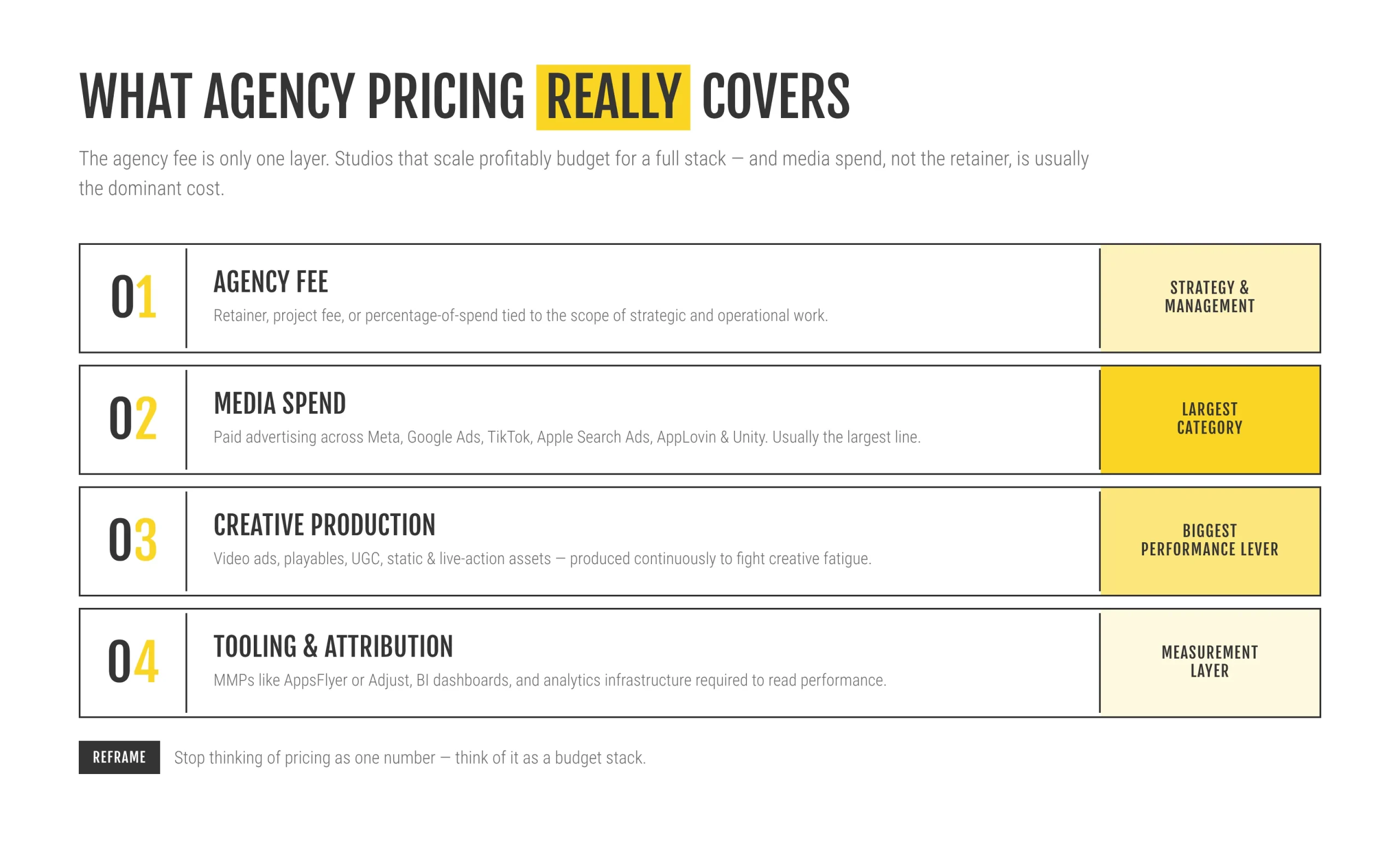
The first layer is the agency fee itself which could be either a retainer, project fee, or percentage-of-spend structure tied to the operational scope of work.
The second layer is media spend. This is usually the largest budget category and includes paid advertising across platforms like Meta, TikTok, Google Ads, Apple Search Ads, AppLovin, Unity, and other advertising platforms. For many studios, this eventually becomes the dominant growth cost.
The third layer is creative production. Modern mobile game advertising relies heavily on continuous creative iteration because fatigue appears quickly across nearly every major paid channel. That means studios increasingly budget separately for video ads, playable ads, UGC production, static assets, live-action shoots, and app store creative assets.
The fourth layer is tooling and attribution infrastructure. Serious mobile game marketing agencies typically work with MMPs like AppsFlyer or Adjust, custom analytics dashboards built on top of BI systems, market intelligence platforms, CRM tools, A/B testing tools, and attribution infrastructure required to run marketing properly.
This is why “agency pricing” is rarely a single number.
A studio spending $20K/month on UA with lightweight creative needs will operate very differently from a AAA mobile publisher managing multi-market paid advertising, influencer partnerships, and aggressive creative production pipelines.
Understanding that operational stack is the first step toward building realistic budgets.
Why Paid UA Takes Such a Large Share of Mobile Game Marketing Budgets
Mobile game user acquisition has become dramatically more expensive over the past several years.
CPIs continue rising across every mobile game genre. Privacy-first attribution systems like iOS SKAN have reduced signal clarity for marketers and advertisers, making optimization harder. Creative fatigue now forces studios to produce significantly more ad variations than even a few years ago, while paid UA channels have fragmented far beyond Meta and Google into TikTok, AppLovin, influencer ecosystems, and creator-driven discovery loops.
According to AppsFlyer’s State of Gaming reports, the mobile gaming industry spent roughly $25 billion on user acquisition in 2025 alone.
Against that backdrop, mobile game marketing agency pricing starts making more sense. Specialized gaming agencies command higher fees because navigating this environment requires deeper know-how by category-focused talent, tooling tailored to games, creative production including custom AI-pipelines, and strategic involvement than generic app marketing agencies can usually provide.
The Average Cost of Mobile Game User Acquisition: Real Benchmarks
Before evaluating agency fees, studios first need to understand what the underlying acquisition economics actually look like.
The average cost of mobile game marketing depends heavily on:
- platform
- geography
- game genre
- monetization model
- competition intensity
- audience quality
These benchmarks help studios understand where their own UA budgets likely fit.
Average CPI by Platform: iOS vs. Android
Across mobile gaming, iOS installs still cost significantly more than Android installs.
Recent benchmarks place:
- iOS US CPI around $4.70
- Android US CPI closer to $3.40
The reason is simple: iOS users generally monetize better through in-app purchases and subscriptions, especially in Western markets. Higher LTV allows advertisers to bid more aggressively for installs.
This is why most premium mobile game marketing agencies still allocate a large percentage of total UA spend toward iOS users despite the higher acquisition cost.
For games with strong monetization systems, higher CPI does not automatically mean worse economics.
Average CPI by Region
Regional pricing variance dramatically changes what a “reasonable” budget looks like.
Recent mobile gaming benchmarks show:
- North America averaging roughly $5.28 CPI
- EMEA around $1.03
- APAC approximately $0.93
- Latin America closer to $0.34
The US alone represented roughly 50% of total gaming UA budgets in 2025.
This matters because a studio launching globally needs to think strategically about market potential and acquisition sequencing. Launching a puzzle game in North America requires fundamentally different budgets than scaling in lower-CPI regions first.
Many mobile game marketing agencies therefore structure test campaigns regionally (e.g. in Philippines for a technical test, in Poland for retention test) before committing larger total UA budgets necessary for expensive tier 1 markets.
Average CPI by Mobile Game Genre
Different mobile game genres carry very different acquisition economics.
Typical CPI benchmarks for Western markets currently look roughly like this:
- casual: $2 – $6
- puzzle: $3 – $6 (match-3: $5 – $8+)
- midcore: $4 – $12
- strategy: $5 – $12 (4X: $10 – $30)
- RPG: $5 – $12
- hardcore: $7 – $20+
- casino: $15 – $30+
Games requiring deeper player commitment usually cost more per install because the addressable audience is smaller while monetization potential is significantly higher.
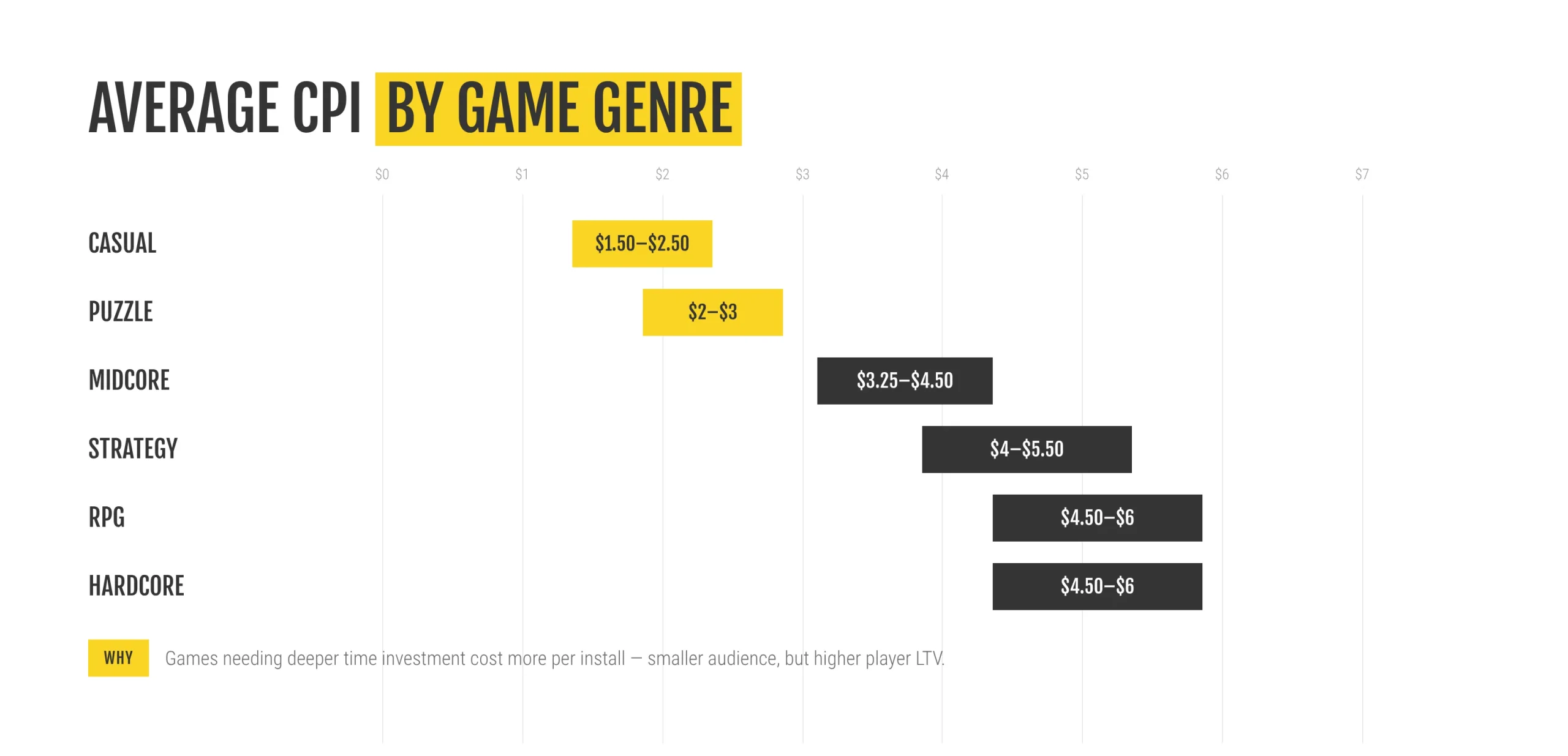
This is why RPG, strategy, and casino mobile projects often require substantially larger marketing budgets than hyper-casual games.
Daily UA Spend Benchmarks: Test vs. Scale
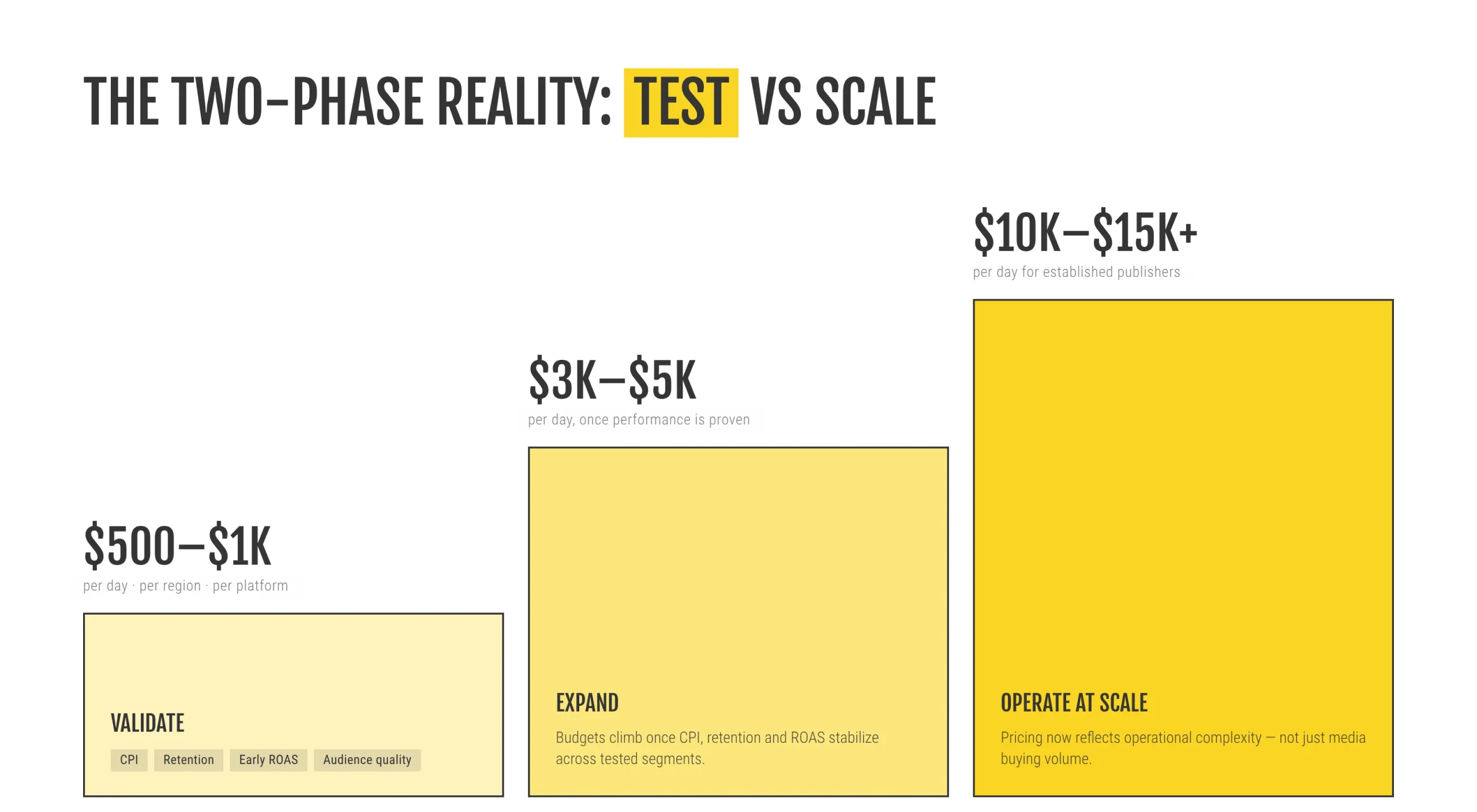
Most successful mobile game growth systems operate in two phases:
- testing
- scaling
During the testing phase, agencies commonly deploy:
- $500–$1,000/day per region and per platform to validate:
- CPI
- retention
- conversion rate
- early ROAS
- audience quality
Once performance stabilizes, scale-phase budgets often increase to:
- $3,000–$5,000/day
Large publishers frequently exceed:
- $10,000–$15,000+/day
At this stage, agency pricing increasingly reflects operational complexity rather than just media buying volume.
How Mobile Game Marketing Agencies Structure Their Pricing
Mobile game marketing agencies usually structure pricing around operational scope, strategic involvement, and long-term growth requirements.
The right model depends heavily on:
- studio stage
- UA budgets
- creative needs
- organizational maturity
- attribution complexity
The strongest agencies structure pricing around long-term growth systems rather than isolated campaign execution.
Strategic Audits and Diagnostic Engagements
The best mobile game marketing agencies rarely start with a media plan.
They start with a diagnostic.
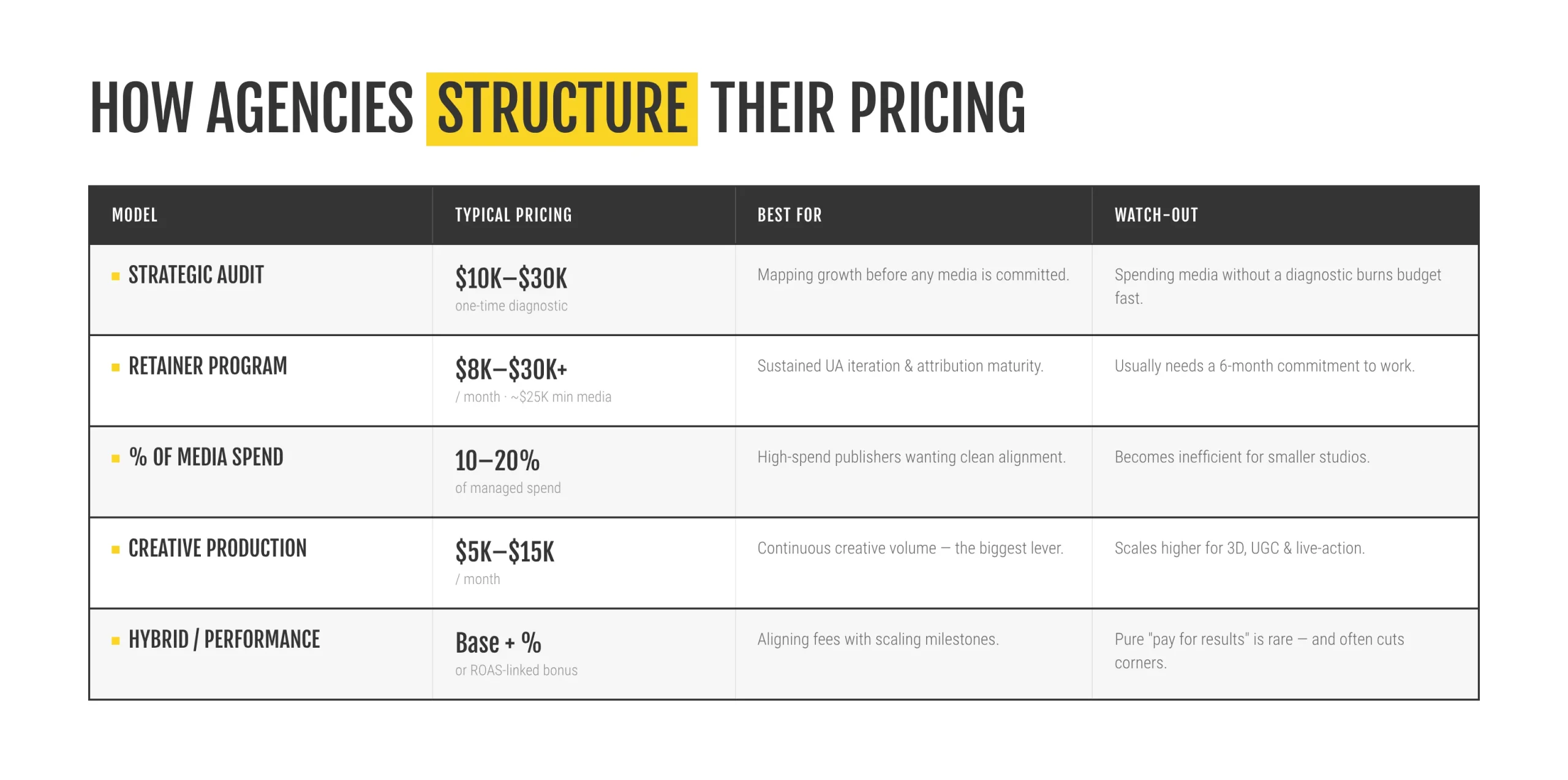
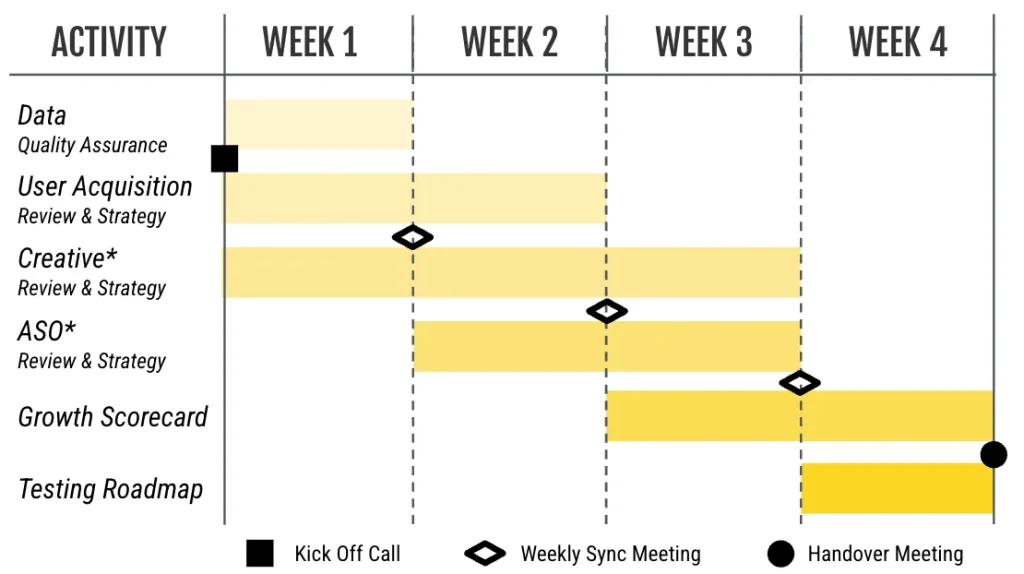
Strategic audits including growth plan and media plan usually range between:
- $10,000–$30,000
depending on scope and complexity.
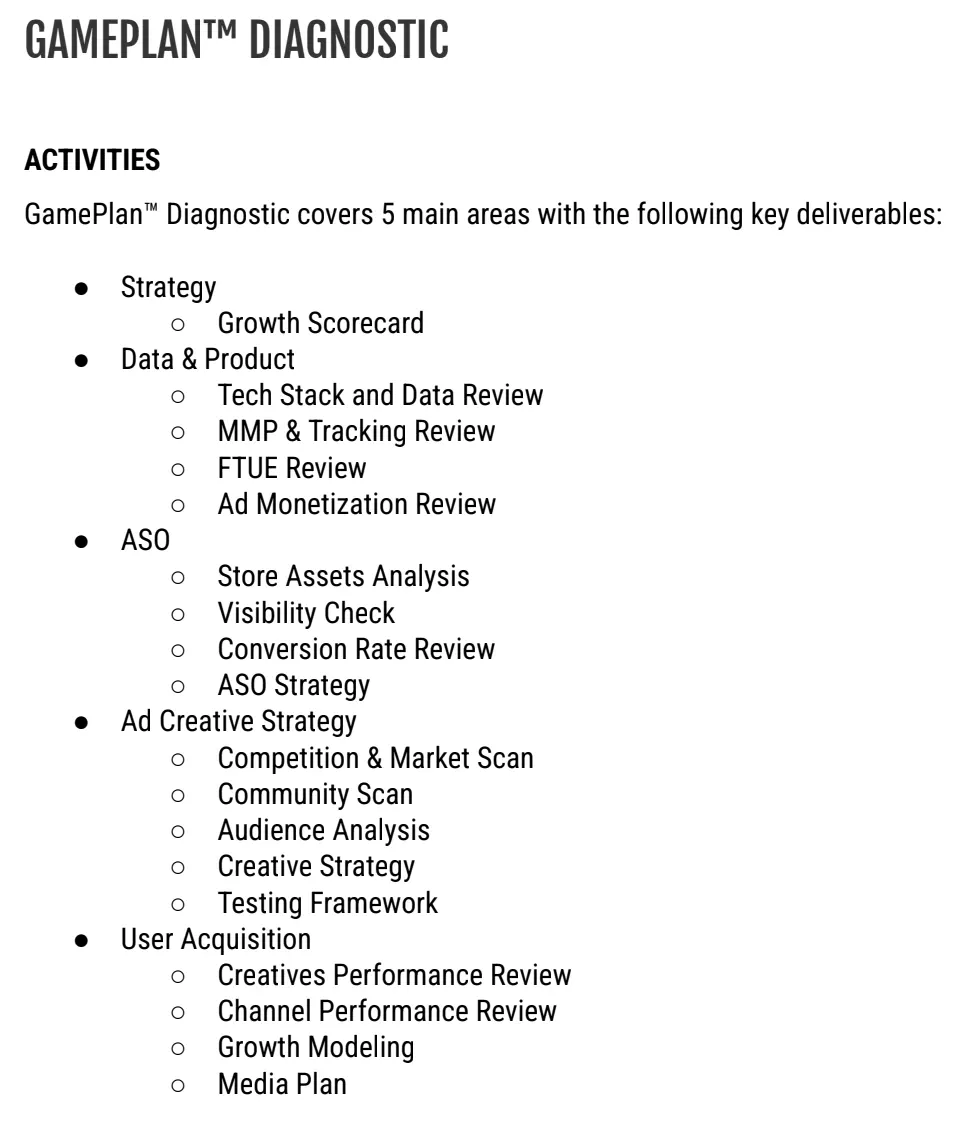
These diagnostics often assess:
- Competitors Review & Market Scan
- Conversion Rate Review and other visibility opportunities
- Audience analysis
- MMP & tracking setup
- Creative Strategy
- FTUE Review and Recommendations
- Growth model
- Media plan
Why does this matter?
Because spending heavily on paid advertising without understanding where growth bottlenecks actually exist is one of the fastest ways studios waste budget.
At AppAgent, GamePlan™ functions as a structured growth diagnostic designed to identify the highest-ROI opportunities across UA, ASO, creative strategy, and monetization before long-term execution begins.
Retainer-Based Growth Programs
Retainer structures are the most common pricing model among specialized mobile game marketing agencies.
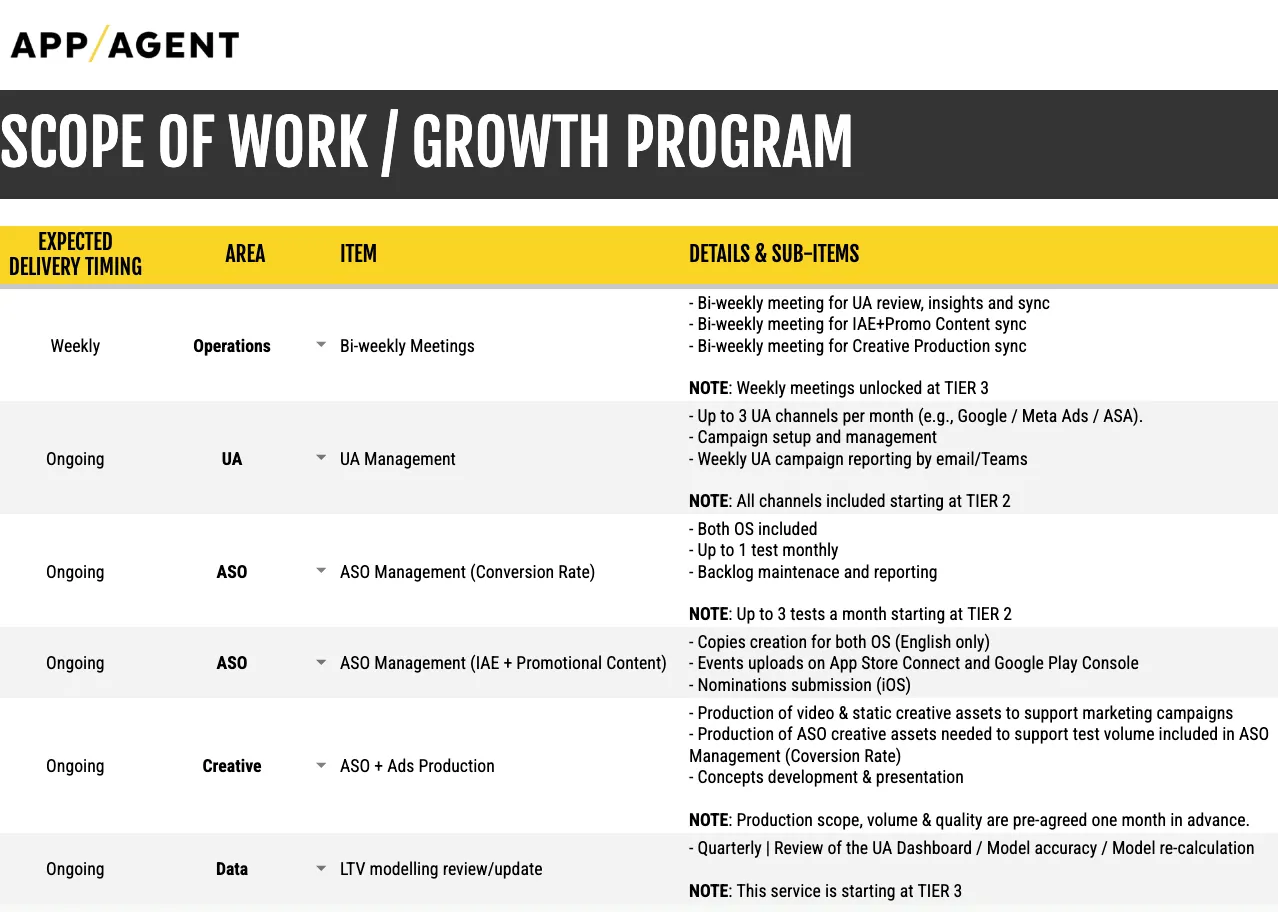
Most growth retainers range between:
- $8,000–$30,000+/month
depending on:
- team seniority
- media budget size
- OS & channels
- reporting requirements
- experimentation complexity
- creative production scope
Most agencies also require minimum media spend thresholds often around:
- $25K/month
Why?
Because profitable user acquisition requires sustained iteration, attribution maturity, and optimization cycles that cannot realistically happen on tiny budgets.
A budget that is too small often limits campaign learning. Platforms need enough conversion volume to identify the right audiences, creatives, placements, and bidding signals. Without that volume, results can be noisy, and optimization decisions may be based on too little data.
For example, a $25K monthly budget might be distributed across channels like this:
| Channel | Monthly Budget | Why This Budget Matters |
|---|---|---|
| Meta Ads | $10K | Allows enough creative testing across OS, placements, and concepts. |
| Google Ads | $5K | Gives the algorithm enough install and post-install signals to optimize toward higher-quality users, not just cheap installs. |
| SDK Networks (Unity/ AppLovin) | $10K | Provides enough scale to test rewarded video, interstitial, and playable ad inventory across publishers. Unity and AppLovin need sufficient install and post-install event volume to optimize toward ROAS, retention, or purchase behavior – not just cheap installs. |
The key point is not that every channel requires the same budget. Rather, each channel needs enough spend to produce meaningful data. If a campaign only generates a handful of conversions per week, it becomes difficult to know whether performance is improving because of strategy, creative quality, algorithmic learning, or simple randomness.
At AppAgent, the Growth Program runs in structured 3-month sprints with predefined KPIs, weekly reporting, and dedicated senior strategic involvement.
Percentage of Media Spend
Some agencies charge based on media managed.
Typical structures range between:
- 10–20% of total ad spend
This aligns incentives well for larger publishers because both parties benefit from profitable scaling.
However, percentage-based pricing can become inefficient for smaller studios where fees consume too much of the overall marketing budget.
For high-spend publishers, though, this model often creates cleaner alignment between agency growth and studio growth.
Project-Based Creative Production
Creative production has become one of the biggest cost categories in mobile game marketing.
Modern creative programs commonly range between:
- $5,000–$20,000+/month
depending on:
- type production complexity
- asset volume including iterations
- localization needs
- AI usage
- UGC scope
- live-action production
Today’s mobile game marketing strategies increasingly rely on continuous creative iteration because ads fatigue typically very quickly across most paid channels.
At AppAgent, the Creative Program combines:
- creative strategy
- concepting
- Static, 2D and 3D video production
- UGC production
- Localization
- Store assets development (icons, screenshots, app preview videos,…)
- Optionally testing creatives
all built around player motivator research and game positioning.
Hybrid and Performance-Based Models
Some agencies combine:
- retainers
- percentage-of-spend pricing
- performance bonuses
into hybrid structures tied to ROAS or scaling milestones.
Pure performance-based pricing remains relatively rare in mobile gaming because attribution complexity makes “pay only for results” models difficult to sustain responsibly.
Studios should also be cautious around agencies promising guaranteed installs or unrealistic low CPI benchmarks before seeing actual data. This often means installs are either incentivized (low quality) or bot farms are used.
How to Choose the Right Mobile Game Marketing Agency for Your Budget
Choosing the right mobile game marketing agency is ultimately less about finding the cheapest option and more about identifying the partner most capable of scaling your game profitably.
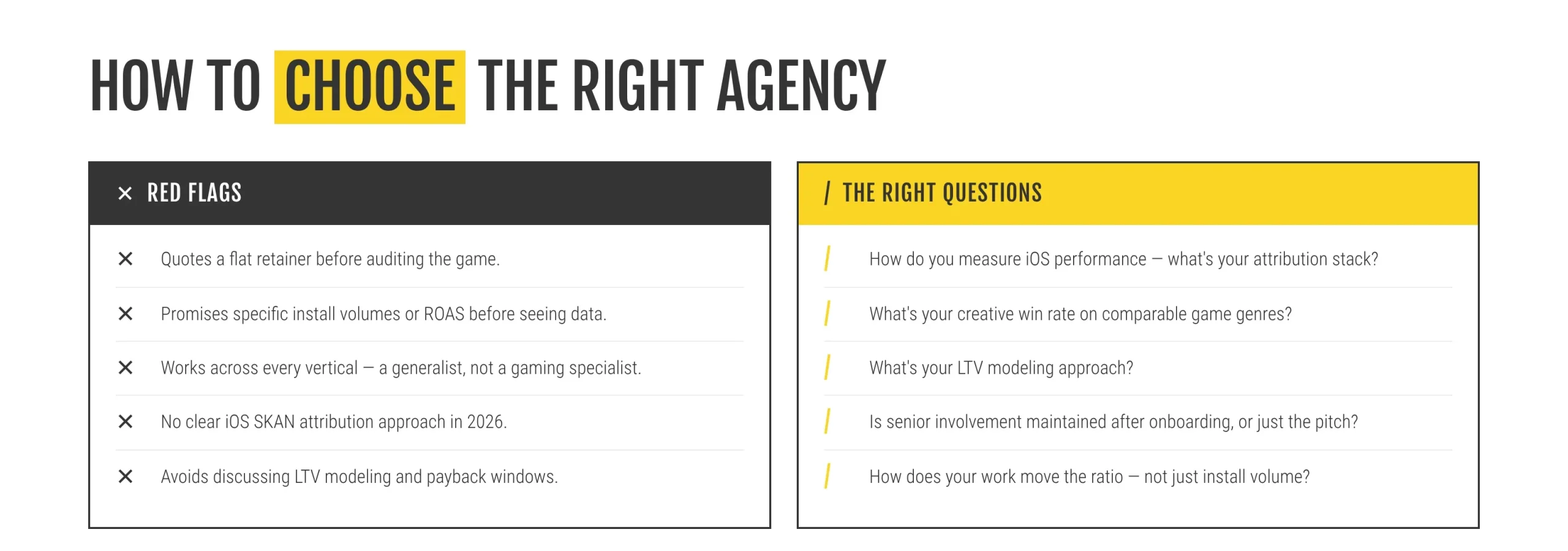
The red flags usually appear early.
Be cautious around agencies that:
- quote flat retainers before auditing the game
- promise specific ROAS targets before reviewing past campaign data
- claim expertise across every vertical
- lack a strong iOS SKAN know-how
- avoid discussing LTV modeling, monetization and payback windows.
A generalist app marketing agency rarely outperforms a true mobile gaming specialist because mobile gaming acquisition behaves differently from broader mobile app ecosystems (e.g. subscription apps or mobile ecommerce)
Studios should also ask deeper operational questions.
How does the agency measure iOS performance?
What is their creative win rate on similar mobile game genres?
How do they approach optimization and experimentation?
Is senior strategic involvement maintained after onboarding, or only during the pitch?
The agency should clearly explain how its work improves business economics – not just how it acquires more installs.
Because profitable mobile game growth depends on efficiency, not just scale.
Scale Profitable Growth with AppAgent
AppAgent is a strategic growth partner for mobile gaming studios.
We help studios understand what they should realistically invest in marketing, where budget is being wasted, and which parts of the growth system need to improve before more spend makes sense.
That matters because profitable mobile game marketing is rarely solved by one channel alone. A studio may need stronger UA management, better creative testing, improved store conversion, cleaner attribution, stronger monetization signals, or a clearer product growth roadmap before scaling spend aggressively.
AppAgent’s work is built around three connected growth layers.
GamePlan™
Every engagement starts with GamePlan™, AppAgent’s strategic diagnostic for identifying the highest-ROI growth opportunities before long-term execution begins.
GamePlan™ evaluates the wider growth system around the game, including product positioning, data infrastructure, attribution, user acquisition, ASO, creative communication, onboarding, and monetization.
For Marvel Puzzle Quest, the GamePlan™ process surfaced 79 growth opportunities and ultimately contributed to +101% Day-7 ROAS YoY on Android and +56% Meta ROAS uplift YoY.
Growth Program
The Growth Program turns prioritized opportunities into structured growth sprints focused on profitable scaling.
Depending on the game’s needs, this can include user acquisition management, ASO, data analysis, product recommendations, reporting, quarterly strategy reviews, and ongoing performance improvement.
The value is not simply “more campaign management.” It is the connection between paid advertising, app store performance, creative testing, data quality, and monetization signals, so studios can make better decisions about where to spend and when to scale.
Creative Program
The Creative Program supports the creative side of mobile game growth: ad concepts, 2D and 3D production, UGC, playable ads, live shoots, localization, store assets, and creative testing.
For mobile games, this matters because creative quality and creative testing velocity often determine whether paid acquisition can scale profitably. A larger media budget only helps if the game has enough winning creative concepts to support that spend.
For DreamLoft’s Game of Words, AppAgent helped drive 65% revenue growth in four months, a 33% creative win rate, and profitable paid UA performance sustained for more than three years.
For Clash of Clans, the team delivered 500+ original ads, multiple sets of store assets including promotional and seasonal campaigns, and live-ops assets supporting in-game events over five years of collaboration.
What separates AppAgent from most mobile game marketing agencies is not execution volume alone.
It is the ability to connect UA, ASO, creative production, product context, monetization, and systematic experimentation into one growth system, with senior strategic involvement across every engagement.
Because effective mobile game marketing is not about buying installs in isolation.
It is about building a profitable long-term growth system around the entire game business.
If you want to understand what your game should realistically budget for profitable scaling, let’s talk.
Frequently Asked Questions About Mobile Game Marketing Agency Pricing
There is no universal budget because mobile game marketing costs depend on the game genre, monetization model, target regions, acquisition goals, creative production needs, attribution setup, and competitive intensity.
Growth-stage studios usually need to think beyond the agency retainer. A realistic mobile game marketing budget often includes agency fees, paid UA spend, creative production, ASO, attribution tooling, reporting, testing infrastructure, and sometimes monetization or product growth support.
For scaling titles, media spend is usually the largest cost. The agency fee is only one part of the total growth investment.
A mobile game marketing agency retainer can include user acquisition management, media planning, creative strategy, ASO, reporting, analytics, experimentation, product page optimization, monetization consulting, and strategic growth planning.
Scope varies significantly between agencies. Some agencies focus mainly on media buying, while others operate as integrated growth partners connecting UA, ASO, creative production, data analysis, and monetization strategy.
Before signing, studios should clarify which channels are included, how creative testing is handled, what reporting looks like, who manages the account day to day, and which KPIs define success.
Usually, no. Media spend is separate from the agency fee.
The agency fee covers the team, strategy, campaign management, creative direction, reporting, analysis, and optimization work. Media spend is the advertising budget paid directly to platforms like Meta, TikTok, Google, Apple Search Ads, AppLovin, Unity, and other acquisition channels.
This distinction matters because a $15,000 monthly agency retainer does not mean the studio has a $15,000 total marketing budget. The full budget may also require paid media, creative production, ASO, MMP tools, analytics, and testing infrastructure.
Pricing differences usually reflect specialization, seniority, creative production depth, number of channels, target markets, data infrastructure, reporting complexity, strategic involvement, and the overall operational scope.
A generalist agency managing one paid channel will price very differently from a mobile gaming specialist supporting UA, ASO, creative testing, attribution, store assets, product insights, and monetization recommendations.
The cheapest proposal is not always the best value. The right agency should explain how its pricing connects to better growth decisions, stronger acquisition efficiency, improved creative performance, or clearer scaling opportunities.
Freelancers can work well for lightweight execution, creative support, metadata updates, early-stage testing, or isolated production needs.
But scaling profitable acquisition across multiple channels and markets usually requires broader infrastructure. A specialized mobile game marketing agency is usually better suited for larger UA budgets, creative testing pipelines, attribution complexity, ASO, monetization analysis, and long-term growth strategy.
The right choice depends on the stage of the game and the complexity of the growth goals. If the studio only needs execution support, freelancers may be enough. If the studio needs a connected growth system, an agency is usually a better fit.
A mobile game marketing agency is worth the cost if its work improves the economics of growth.
That can mean stronger ROAS, better payback windows, higher creative win rate, improved store conversion, more efficient media spend, clearer attribution, stronger retention quality, or better scaling decisions.
The agency should be able to explain what changed, what was learned, which opportunities were prioritized, how budget was reallocated, and how the work connects to business outcomes. If the agency only reports activity without connecting it to growth efficiency or revenue impact, the pricing is harder to justify.
Related Pricing Guides
If you want to compare specific parts of the mobile growth budget, these guides may also help:
- User Acquisition Agency Pricing: What Mobile UA Management Costs
- App Store Optimization Pricing: What ASO Costs and What Impacts the Budget
If you are still comparing partners, see our guide to the best growth marketing agencies for mobile games.