This guide focuses specifically on app store optimization pricing. For paid user acquisition management costs, see our user acquisition agency pricing guide. For the full mobile game marketing budget, see our mobile game marketing agency pricing guide.
Scaling organic installs sounds cheaper than paid acquisition.
Until the quotes start arriving.
One ASO agency proposes a $2,500 monthly retainer. Another recommends a $12,000 growth program. A freelancer offers a metadata refresh for $1,500, while enterprise platforms pitch annual contracts worth more than some indie studios spend on paid user acquisition in an entire year.
That pricing gap creates confusion for a lot of mobile publishers.
The problem is that App Store Optimization is no longer a single service. Modern ASO sits at the intersection of keyword strategy, conversion optimization, in-app events & promotional content, ratings & reviews, localization, and even paid acquisition efficiency – especially because of close connection with Apple Search Ads on iOS. Two vendors can both sell “ASO” while delivering completely different levels of operational depth.
And that matters because under-investing in ASO often becomes more expensive than over-investing.
Every install generated organically instead of through paid acquisition protects margin. Every improvement in store conversion rate makes paid traffic more efficient.
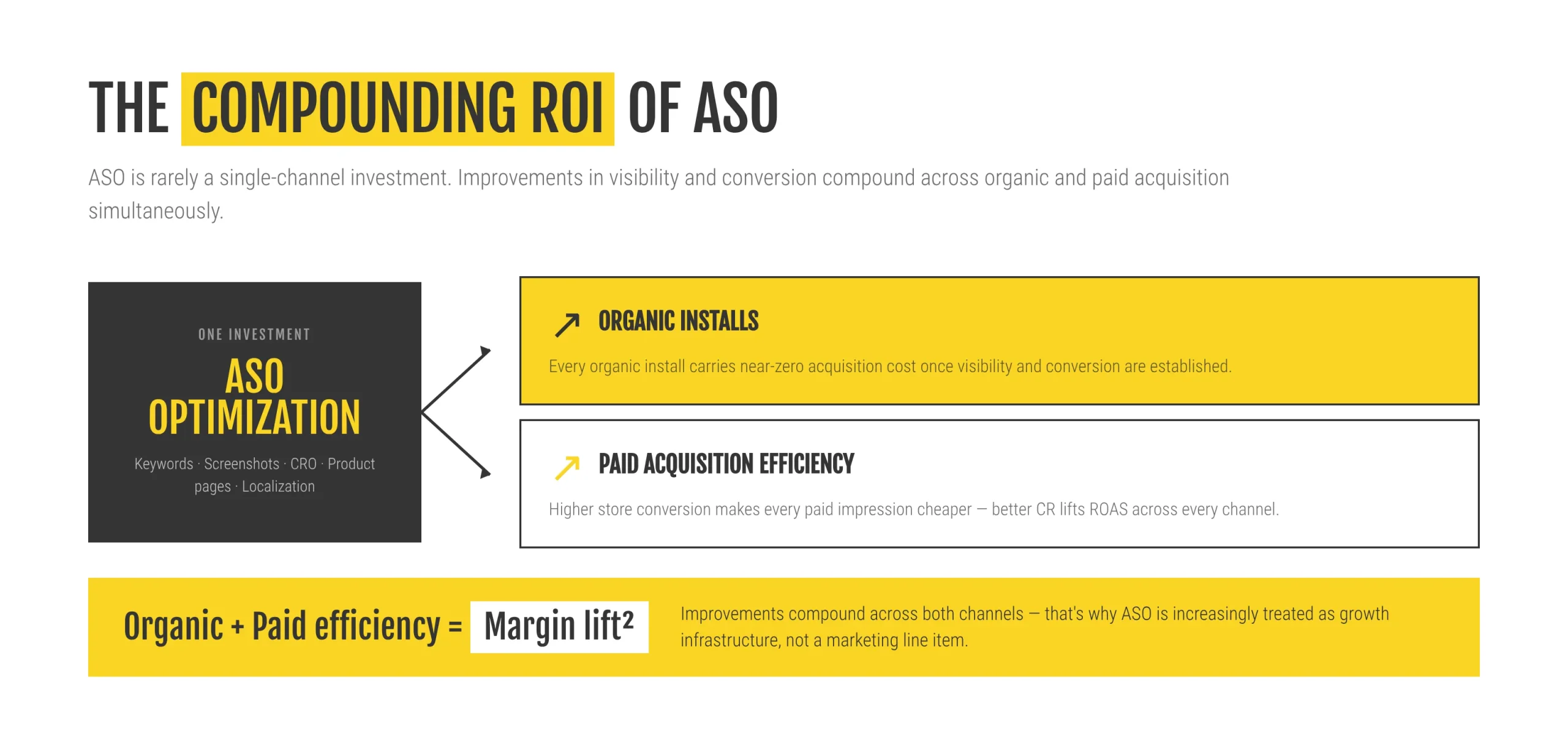
Every optimization to screenshots, metadata, or product pages compounds over time.
In this guide, we break down what app store optimization pricing actually looks like in 2026, what drives the budget, how different engagement models work, and how serious mobile publishers should evaluate whether an ASO investment is financially justified.
What Is App Store Optimization and Why Does ASO Pricing Vary So Much?
App Store Optimization (ASO) is the practice of improving an app’s visibility and conversion rate on the Apple App Store and Google Play to drive organic installs.
Much like traditional search engine optimization for the web, ASO focuses on improving how apps appear in search results inside the app stores while simultaneously increasing conversion efficiency once users land on the store page.
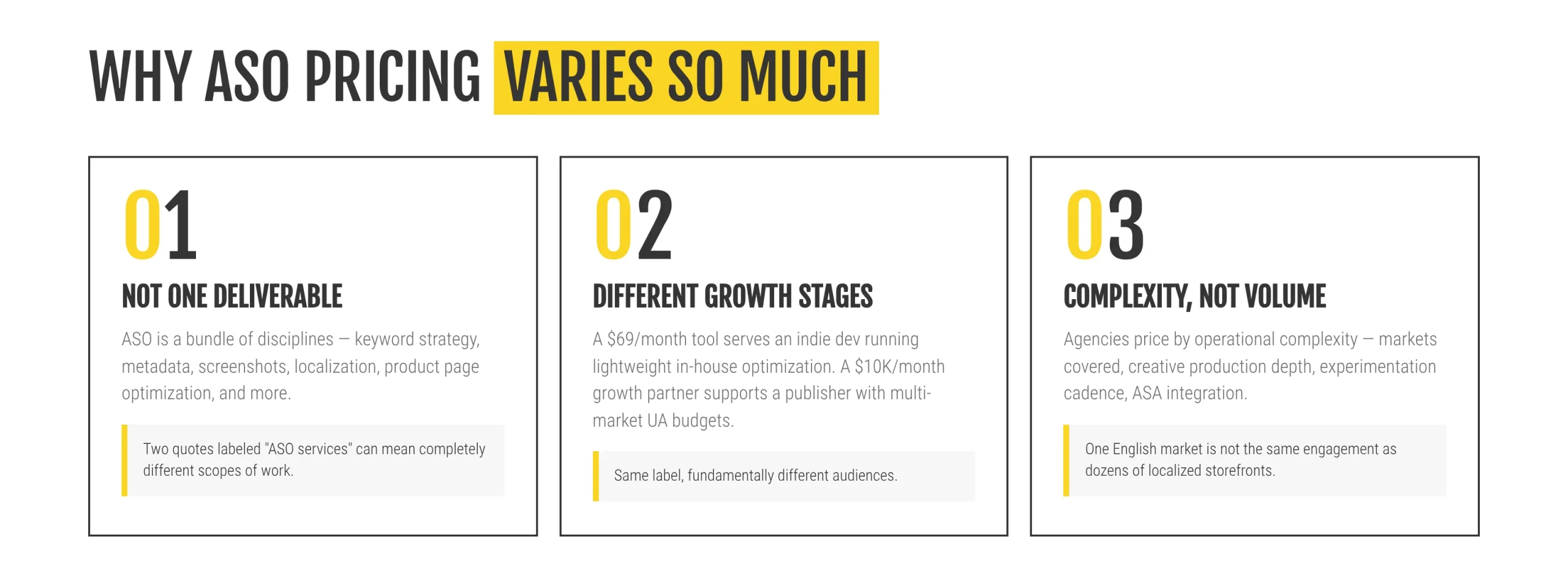
ASO pricing varies dramatically for three reasons.
First, ASO is not a single deliverable. It is a bundle of disciplines that can include keyword research, metadata optimization, screenshot testing, app icon experimentation, localization, product page optimization, creative asset production, competitor monitoring, and ongoing ranking analysis. Two quotes labeled “ASO services” can therefore represent completely different scopes of work.
Second, different vendors serve completely different growth stages. A $69/month ASO tool is designed for an indie developer running lightweight optimization in-house. A $10,000/month ASO growth partner is usually supporting a publisher managing large paid UA budgets across multiple markets.
Third, agencies typically price based on operational complexity rather than output volume. An ASO engagement optimizing metadata for a single English-speaking market is fundamentally different from a multi-market growth program combining localization, conversion rate optimization, product page experimentation, creative asset production, and Apple Search Ads alignment across dozens of storefronts.
That is why publishers cannot compare ASO quotes side-by-side without understanding what is actually being delivered first.
How Much Does App Store Optimization Cost?
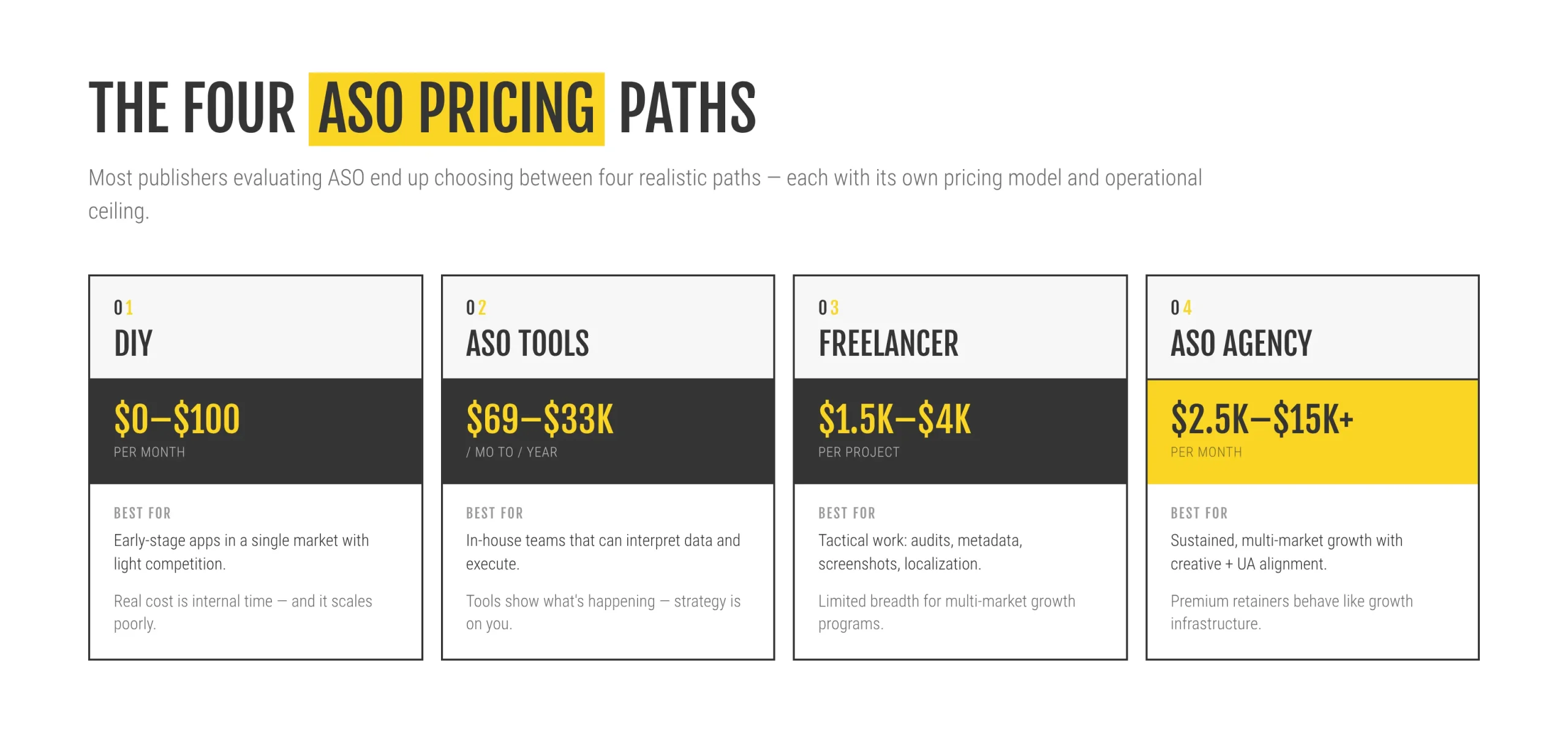
Most publishers evaluating ASO end up choosing between four realistic paths:
- DIY optimization
- ASO tools and platforms
- freelancers or consultants
- a dedicated ASO agency
Each comes with its own pricing model and operational ceiling.
DIY ASO Cost (The Developer-Led Path)
The lowest-cost option is handling ASO internally.
In practice, this usually means a developer, founder, or marketer using App Store Connect and Google Play Console data, manually researching keywords through app store search suggestions, writing metadata internally, and creating screenshots in Figma or lightweight screenshot tools.
The direct cost can range from essentially $0 to roughly $100/month for basic tooling.
But the real expense is internal time.
DIY ASO can work for very early-stage mobile apps operating in one market with limited competition. The challenge is that it scales poorly. Manual workflows make it difficult to monitor competitor movements, identify keyword opportunities at scale, or sustain structured experimentation over time.
Eventually, most publishers hit a ceiling where the cost of internal bandwidth becomes larger than the cost of professional optimization.
ASO Tool and Platform Pricing
ASO tools provide the infrastructure layer behind optimization.
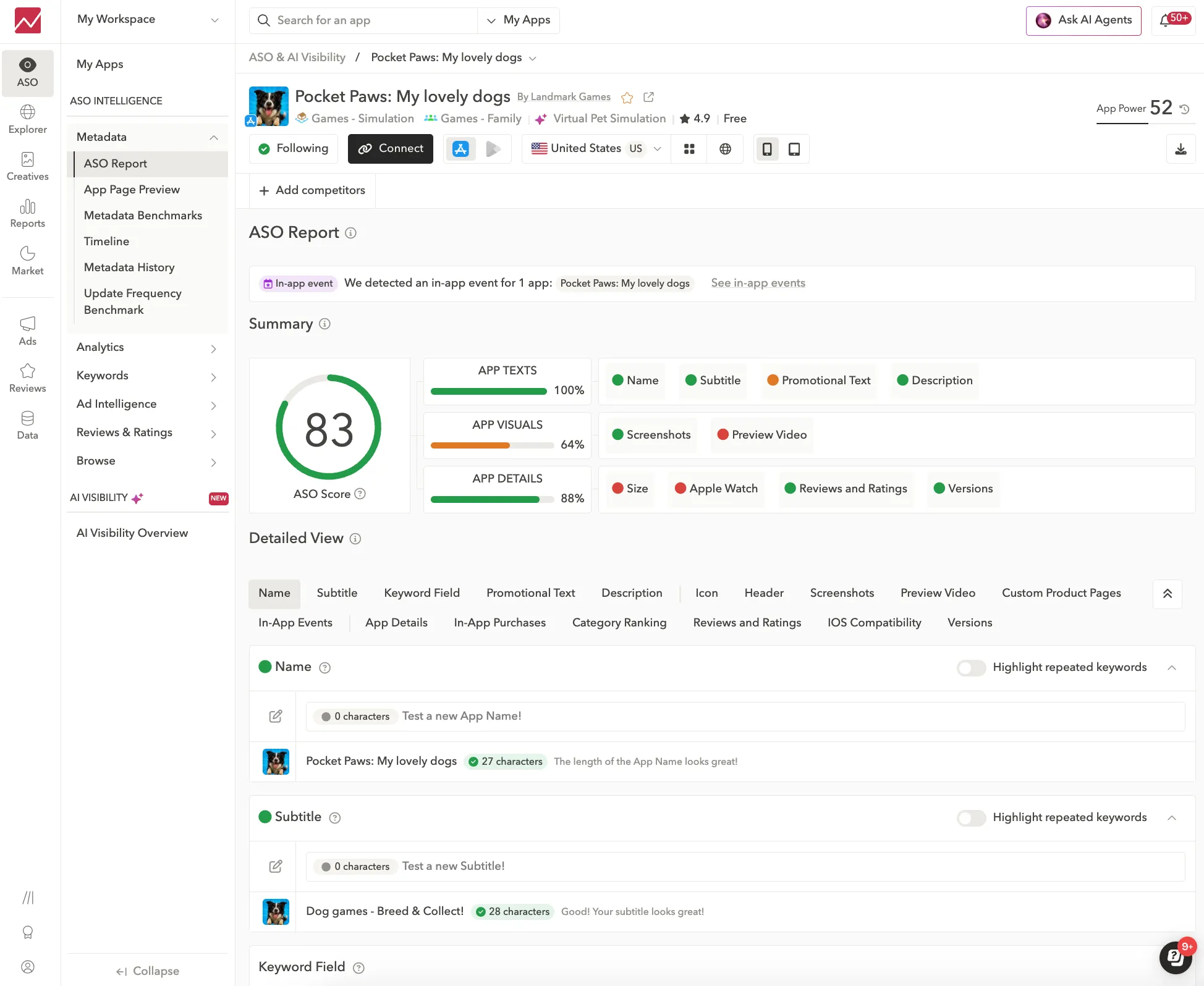
They help teams with:
- keyword research
- rank tracking
- competitor monitoring
- store visibility analysis
- metadata insights
- experimentation workflows
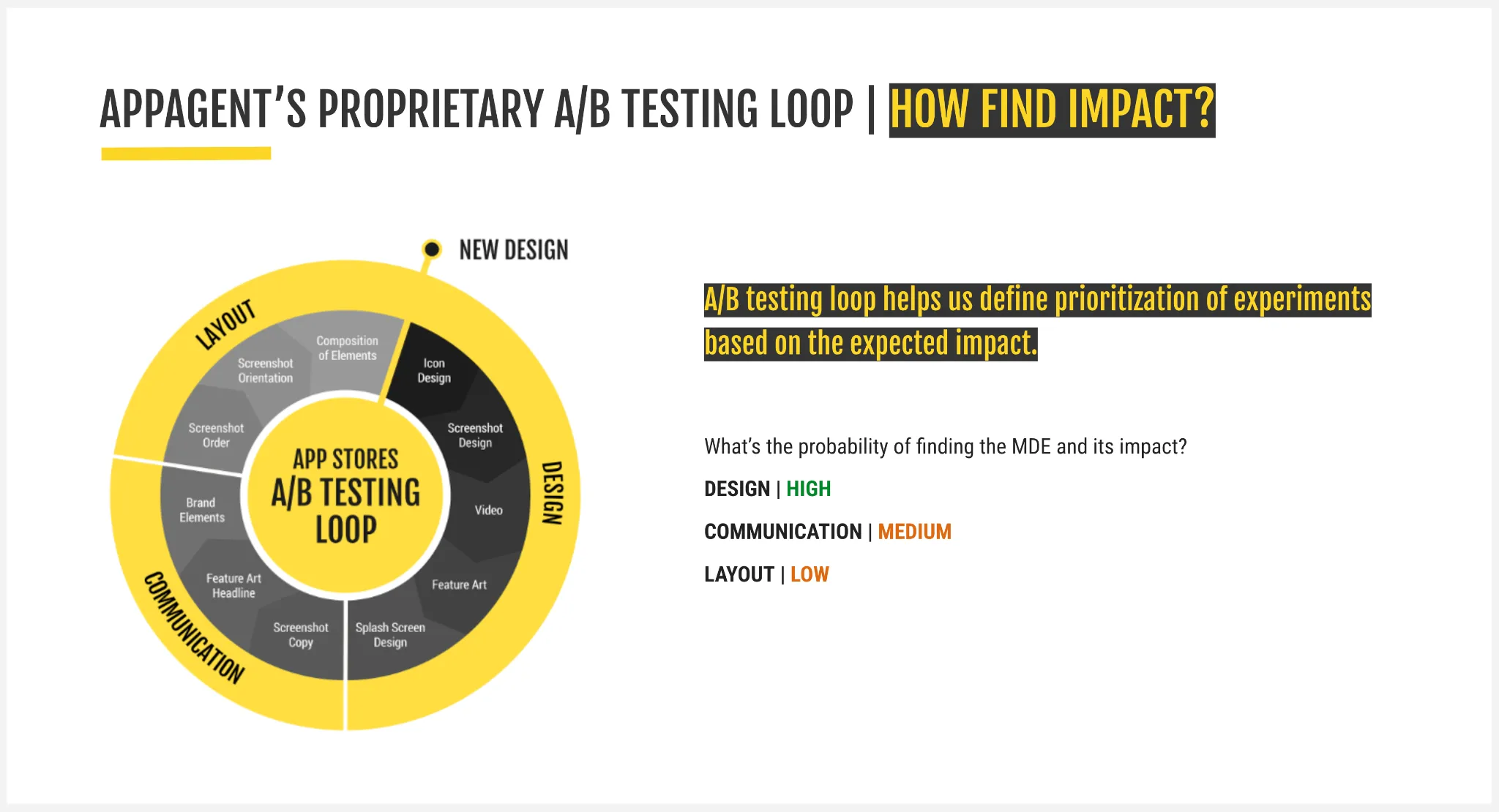
- A/B testing
Entry-level ASO platforms typically start around $69/month, while advanced optimization suites can scale into the hundreds of dollars monthly. Enterprise experimentation and product page testing platforms like SplitMetrics can cost $13,000–$33,000 per year.
But an ASO platform is ultimately a data source — not a strategy.
The platform shows you what is happening, but a team still has to act on it unless you partner with agencies that operate inside these tools (such as AppTweak or Splitmetrics Agency).
The difference between average and elite ASO performance usually comes from experimentation velocity, creative interpretation, prioritization, and not simply access to keyword data.
This pricing tier works best for teams that already have someone internally capable of interpreting the data and executing optimization consistently.
Freelancer and Consultant ASO Cost
Freelancers sit between DIY optimization and full-service agency support.
A typical ASO freelancer engagement ranges from roughly $1,500–$4,000 for a one-time audit, metadata refresh, or strategic review. Some consultants also work hourly when advising in-house growth or ASO teams.
This option can be highly cost-effective for tactical work:
- keyword audits
- metadata optimization
- screenshot redesigns
- localization recommendations
- store listing reviews
The trade-off is operational breadth.
Most freelancers cannot realistically support multi-market ASO programs, integrate ASO with paid user acquisition, manage structured creative testing pipelines, or sustain long-term experimentation cycles across multiple app stores.
For publishers with meaningful acquisition ambitions, freelancer support often becomes a transitional solution rather than a long-term growth system.
ASO Agency Pricing
Most mid-to-late stage mobile apps eventually move toward some form of agency partnership.
Boutique and mid-market ASO agencies typically charge between $2,500–$7,000/month for ongoing keyword optimization, metadata management, reporting, and basic creative testing across one or two stores.
Full-service specialist agencies usually operate in the $7,000–$15,000+/month range.
At that level, engagements often include:
- dedicated account leadership
- deep creative production
- localization programs
- structured experimentation systems
- product page optimization
- conversion-rate optimization
- paid UA alignment
- ongoing reporting and iteration
The highest-performing ASO engagements usually involve significantly more than metadata optimization. They combine creative production, localization, conversion-rate optimization, product page testing, experimentation systems, paid UA alignment, and ongoing iteration cycles.
This is why premium ASO retainers often resemble growth infrastructure investments more than standalone marketing services.
Pricing generally scales with three variables:
- app category competitiveness
- number of markets being optimized
- depth of creative production included
A finance subscription app competing globally will naturally require a larger optimization system than a utility app operating in one low-competition region.
At AppAgent, ASO engagements typically begin with GamePlan™ which is a strategic diagnostic that maps the highest-ROI opportunities across ASO, UA, product, and creative before any long-term retainer scope is built.
The goal is simple:
avoid paying for optimization work that will not materially move growth metrics.
What Does an ASO Agency Actually Do?
Modern ASO agencies are responsible for far more than keyword optimization and metadata management.
Today’s ASO work often includes:
- Search optimization including ranking monitoring
- competitor analysis
- conversion-rate optimization (screenshot testing, app icon experimentation, app preview video testing)
- Custom product pages optimization
- creative asset iteration
- localization strategy
- Reviews and ratings tracking
- App vitals tracking and optimization
- Apple Search Ads management
- App Store and Google Play experimentation
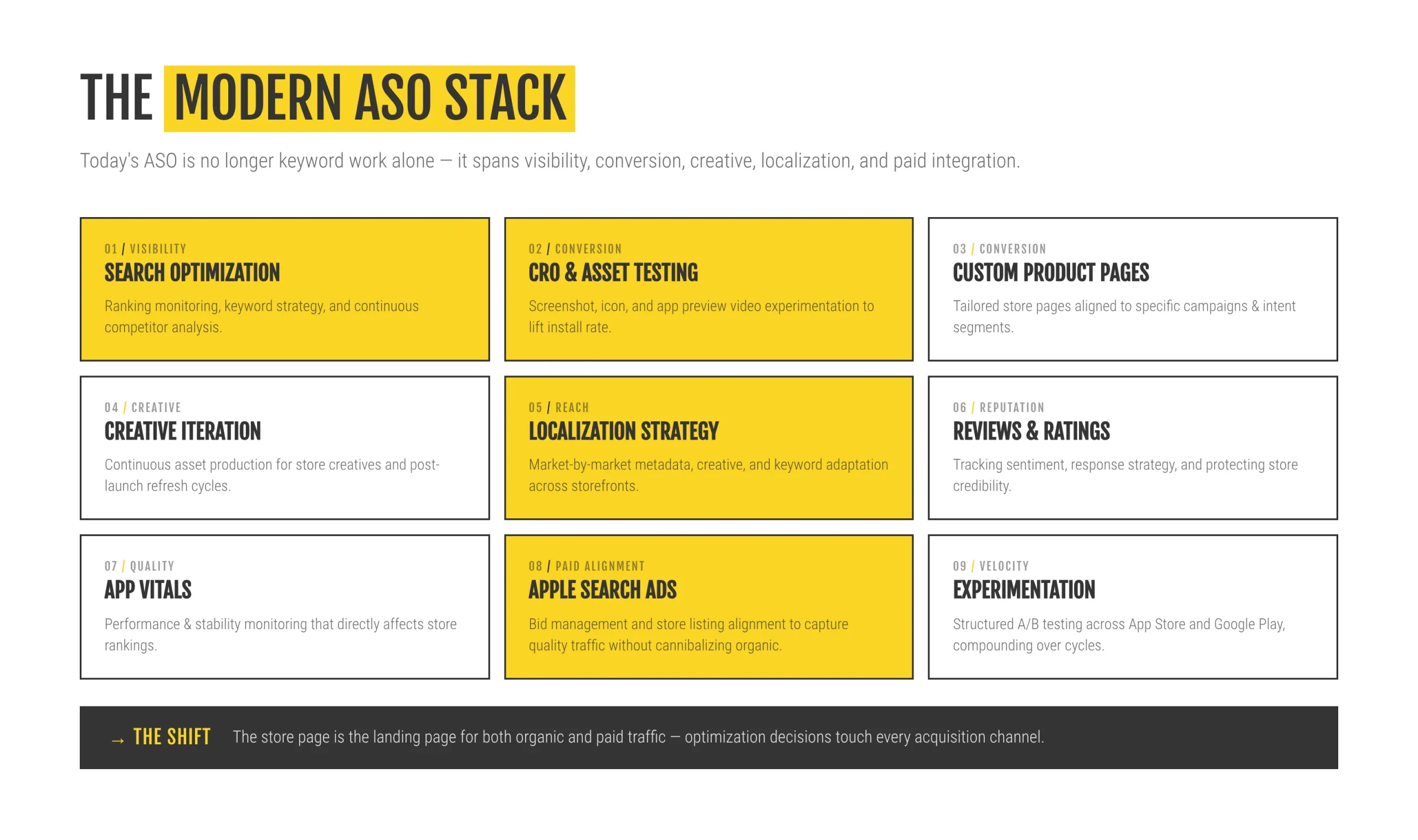
Modern ASO is no longer limited to “keyword ranking” work alone.
The strongest ASO strategies combine keyword visibility improvements with conversion-rate testing designed to increase both organic installs and paid acquisition efficiency over time, including localization, custom product pages optimization for alignment with tactical campaigns and Apple Search Ads alignment to help capture high-intent traffic without unnecessarily cannibalizing organic downloads.
That matters because the app store page effectively functions as the landing page for both organic and paid traffic. If screenshots, icons, or messaging convert poorly, acquisition efficiency suffers everywhere.
This is also why mature mobile publishers increasingly connect ASO directly to broader app marketing and acquisition systems. Store conversion improvements influence how efficiently paid campaigns scale, while creative learnings from paid acquisition often feed back into app store optimization decisions and vice versa.
The strongest growth teams therefore treat ASO less like an isolated marketing service and more like an ongoing experimentation middle layer sitting between product, creative, and acquisition strategy.
Common ASO Pricing Models and Engagement Types
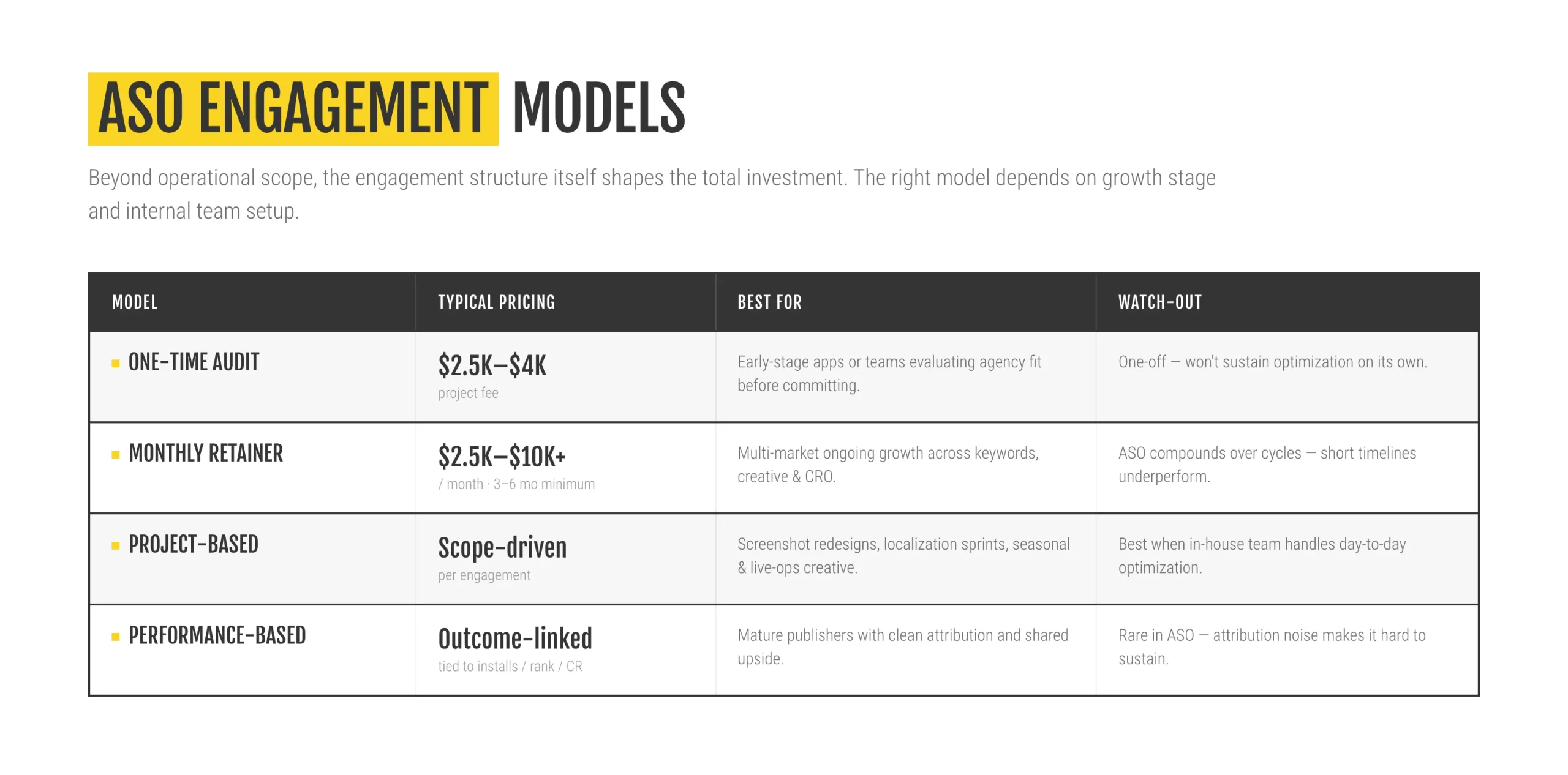
Beyond operational scope, pricing structure itself also shapes the total investment.
Different engagement models work better for different growth stages and internal team structures.
One-Time ASO Audit
The lowest-commitment option is usually a one-time ASO audit.
These projects typically cost between $2,000–$7,000 and usually include:
- keyword strategy
- competitor analysis
- metadata recommendations
- creative observations
- optimization roadmap
This is often the right starting point for:
- early-stage apps
- publishers new to ASO
- teams evaluating agency fit
- companies preparing for larger growth initiatives
A strong audit can reveal where the highest-leverage opportunities exist before committing to a long-term retainer.
Monthly Retainer
Monthly retainers are the most common ASO engagement structure.
Most ongoing ASO retainers range between $2,500–$10,000+/month depending on:
- market coverage
- experimentation cadence
- localization scope
- creative production depth
- reporting complexity
Retainers usually include:
- keyword optimization
- metadata updates
- creative testing
- product page experimentation
- conversion analysis
- reporting
- ongoing iteration cycles
Most agencies require at least a 3–6 month commitment because ASO improvements compound over multiple optimization cycles rather than instantly.
Project-Based Pricing
Project-based engagements work well for publishers needing focused bursts of execution.
Examples include:
- screenshot redesigns
- Seasonal assets
- Live-ops promotion
- localization expansions
- Custom product page design
- metadata refreshes
- Adding an app preview video
This model works best when the in-house team handles day-to-day optimization while the agency supports specialized projects.
Performance-Based Pricing
Performance-based pricing is less common in ASO.
In these engagements, part of the agency fee is tied to measurable outcomes like:
- install growth
- keyword ranking improvements / visibility improvements
- conversion-rate lifts
The model sounds attractive in theory, but attribution is difficult.
Organic install growth takes time to stabilize, there’s always spillover from paid campaigns (misattributions), and many external variables influence ranking and visibility.
Because of that, most agencies are reluctant to absorb significant performance risk without upside-sharing structures.
The ROI of Investing in App Store Optimization
ASO should be evaluated as an investment in acquisition efficiency.
For mature publishers, ASO increasingly functions as core app growth infrastructure because improvements in visibility, conversion rate, and acquisition efficiency compound across both organic and paid channels over time.
Organic installs effectively carry near-zero acquisition cost once visibility and conversion systems are established. Paid acquisition, meanwhile, continues getting more expensive.
Average mobile CPIs commonly range between:
- $2–$10 on iOS
- $1–$5 on Android
with significantly higher acquisition costs in competitive categories like casino, RPG or strategy games.
Every install generated through improved store visibility instead of paid spend protects margin.
But the compounding effect is even larger than that.
Improving store conversion rates also makes paid acquisition more efficient because paid users land on a higher-converting product page.
That means ASO investment improves both:
- organic growth
- paid acquisition economics
simultaneously.
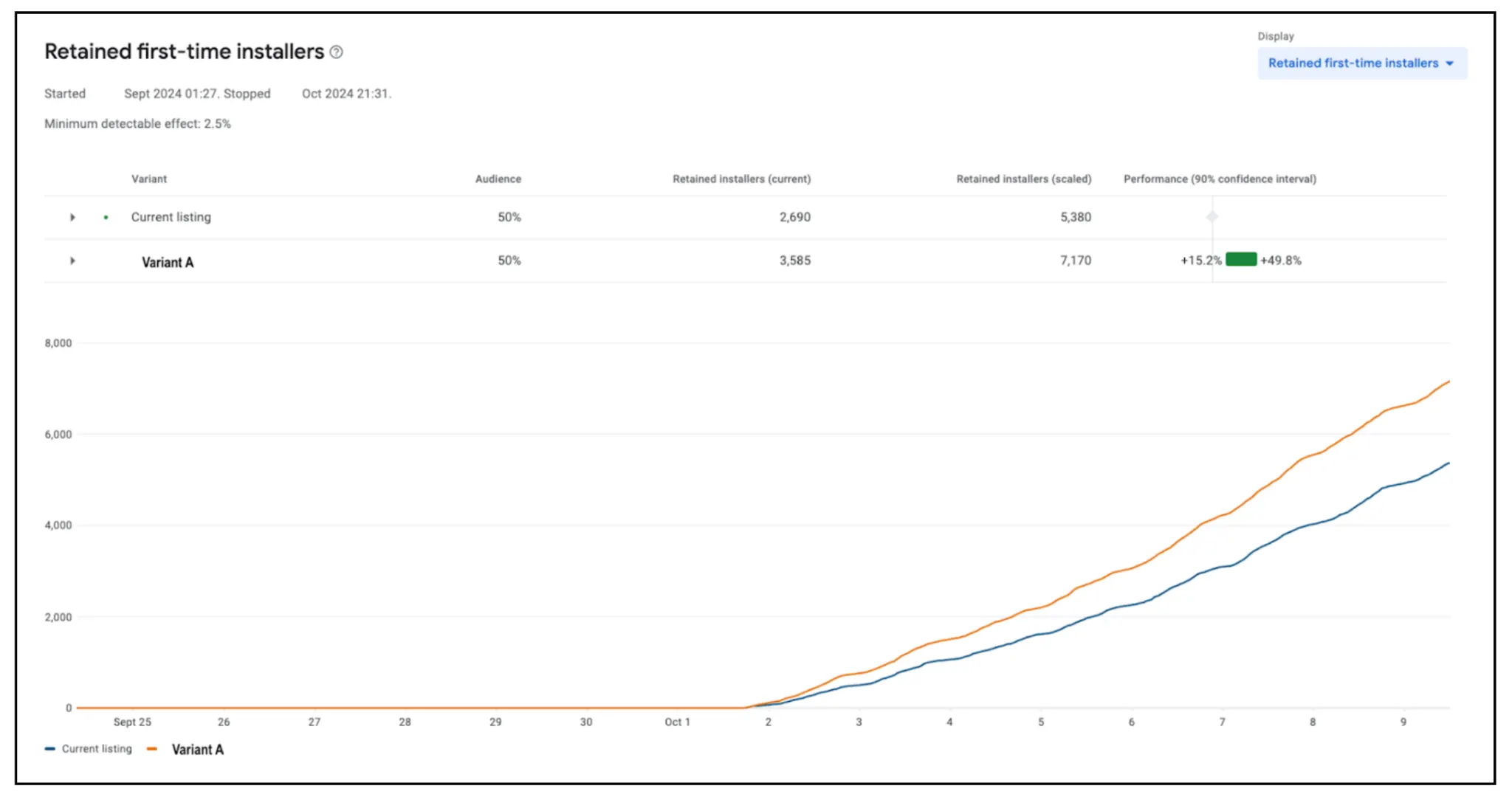
Structured ASO programs have produced significant performance gains for publishers operating at scale.
Games implementing sustained ASO optimization that we’ve managed saw:
- +54% iOS conversion rate in the US within 6 months (Star Stable Online)
- 8× growth in organic installs on iOS after hitting the #1 ranking for the “dog games” keyword (Pocket Paws)
These outcomes rarely come from keyword optimization alone.
They usually result from combinations of:
- screenshot experimentation
- metadata restructuring
- localization
- product page optimization
- fast creative testing cycles
- gaining insights from app reviews
At scale, these kinds of gains make the “is ASO worth it?” conversation almost rhetorical.
Get Your App on a Profitable Growth Path With AppAgent
AppAgent is a strategic growth partner for mobile gaming studios.
We help teams understand where ASO can actually move business results: stronger store visibility, higher product page conversion, better paid traffic efficiency, and clearer alignment between app store messaging, creative strategy, and user acquisition.
Instead of treating ASO as isolated keyword work, we look at the app store as one part of the wider growth system around the game.
GamePlan™
Every engagement starts with GamePlan™, AppAgent’s strategic diagnostic for identifying the highest-ROI growth opportunities before long-term execution begins.
For ASO, that means looking beyond metadata alone. GamePlan™ evaluates where store visibility, conversion rate, creative communication, paid acquisition, onboarding, monetization, and data signals may be limiting growth.
For Marvel Puzzle Quest, this process surfaced 79 growth opportunities and ultimately contributed to +101% D7 ROAS YoY on Android.
Growth Program
The Growth Program turns prioritized opportunities into structured 3-month execution sprints.
For ASO, this can include improving store visibility, increasing product page conversion, aligning custom product pages with paid campaigns, connecting Apple Search Ads learnings with organic search, and using reporting to understand which changes are actually improving acquisition efficiency.
This matters because ASO does not only influence organic installs. For scaling games, a stronger store page can also make paid traffic convert more efficiently.
Creative Program
The Creative Program supports the visual side of app store performance: app icons, screenshots, preview videos, custom product page assets, playable ads, and paid creatives.
For ASO, this matters because store creative is often the difference between visibility and actual installs. A game can rank for the right keywords and still lose users if the icon, screenshots, or store message fail to communicate the right player motivation.
For Star Stable Online, structured ASO experimentation involving more than 30 store experiments across six months helped double store conversion rate.
For Clash Royale, RPG-themed store creative helped stabilize and reverse declining store conversion performance.
For Wordling, AppAgent doubled organic users from the US, Spain, and Italy through keyword optimization on iOS and reached the top 3 in the US for the main keyword.
What differentiates AppAgent is not execution volume alone. It is the ability to connect ASO, Apple Search Ads, paid UA, creative development, and product context into one growth system.
Because ultimately, effective ASO is not about chasing rankings in isolation.
It is about helping the right players understand why your game is worth installing — and making both organic and paid acquisition work harder.
If you want to understand where the highest-ROI ASO opportunities actually are for your app, let’s talk.
Frequently Asked Questions About ASO Pricing
ASO pricing depends on the app category, number of markets, localization scope, update frequency, creative testing needs, and whether the work is limited to metadata or connected to paid acquisition and store conversion.
Smaller ASO engagements usually focus on keyword research, metadata optimization, and basic reporting. Larger programs often include product page testing, app icon and screenshot experimentation, localization, custom product pages, Apple Search Ads alignment, and ongoing analysis across both the Apple App Store and Google Play.
For serious mobile publishers and game studios, ASO is usually not priced as a one-time keyword task. It is priced as an ongoing growth function designed to improve visibility, store conversion, and acquisition efficiency over time.
ASO for mobile games often costs more than basic app store optimization because game studios usually need more creative testing, seasonal updates, localization, live-ops support, app icon experimentation, screenshot iterations, and closer alignment with paid user acquisition.
A simple metadata refresh may be enough for an early-stage game in one market. But a scaling mobile game usually needs a broader ASO system that connects keyword visibility, store conversion, player motivation, creative testing, Apple Search Ads, and paid UA learnings.
That is why ASO pricing for mobile games is usually driven less by the number of keywords and more by the level of experimentation needed to improve organic installs and paid acquisition efficiency.
ASO agency pricing can include keyword research, metadata optimization, competitor analysis, store listing reviews, app icon testing, screenshot testing, app preview video recommendations, localization, custom product page optimization, reporting, and ranking analysis.
More advanced ASO engagements may also include Apple Search Ads alignment, creative asset production, store conversion-rate testing, review analysis, and coordination with paid user acquisition teams.
This is why two ASO agencies can quote very different prices for what appears to be the same service. One may only optimize metadata, while another may support a full app store growth system.
ASO tools are useful for keyword research, rank tracking, competitor monitoring, visibility analysis, metadata insights, and experiment planning.
But tools do not create the strategy by themselves. A team still needs to decide which keywords matter, what positioning to test, how to interpret ranking changes, which markets to prioritize, and how ASO connects to paid acquisition and product performance.
ASO tools are usually enough for teams with strong internal expertise and time to execute consistently. Agencies become more valuable when the app needs senior prioritization, creative interpretation, localization strategy, experimentation discipline, and ongoing execution.
Metadata changes and keyword updates can influence app store rankings within a few weeks, but meaningful ASO impact usually compounds over several months.
The fastest wins often come from fixing weak metadata, improving the first impression of the store page, or aligning screenshots and messaging with user intent. Larger gains usually come from repeated experimentation across keywords, creative assets, product pages, localization, reviews, and paid UA feedback loops.
ASO is cumulative by nature. The strongest results usually come from continuous testing rather than one-time updates.
Related Pricing Guides
If you are comparing broader growth budgets, these guides may also help:
- User Acquisition Agency Pricing: What Mobile UA Management Costs
- Mobile Game Marketing Agency Pricing: What Studios Should Budget For
If you are still comparing partners, see our guide to the best ASO agencies for mobile games.