You built something players love. Then you ship it, and almost nothing happens. This is the quiet heartbreak behind thousands of good games every month: a title nobody can find. Your next ad is not competing with other games for attention; it is competing with the 977 other commercial messages a player sees in a single day.
Quality alone no longer earns downloads, and even a brilliant game disappears without a system behind it.
This guide breaks that system into the parts that move revenue, names the frameworks we use to run them, and shows the real numbers they produced. Some of it may challenge how many teams approach mobile game advertising today.
What Is Mobile Game Marketing?
Mobile game marketing is the end-to-end process of attracting, converting, and retaining high-quality players for a game profitably, combining paid user acquisition, app store optimization, community and content, and data-driven measurement.
Notice what that definition does not say. It does not say “buy installs.” Many teams still treat the work as media-buying: pour money into Meta and Google, watch the install counter climb, and hope revenue follows. That model gets more fragile every quarter.
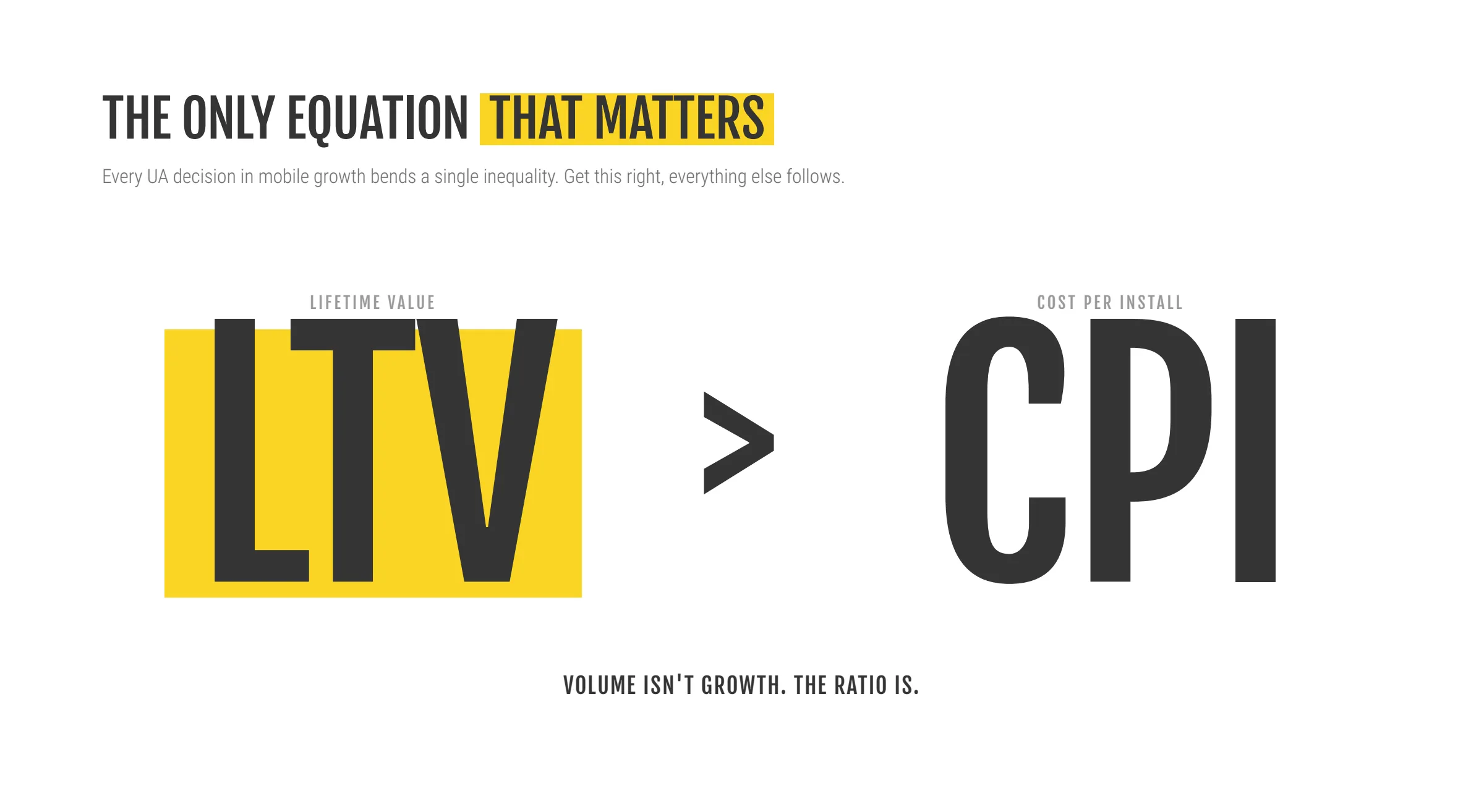
The cleaner way to think about the whole discipline is one inequality our Head of Growth, Roberto Sbrolla, puts at the center of every audit: LTV must exceed CPI. The lifetime value of a player has to beat the cost of acquiring them, with enough margin left to reinvest.
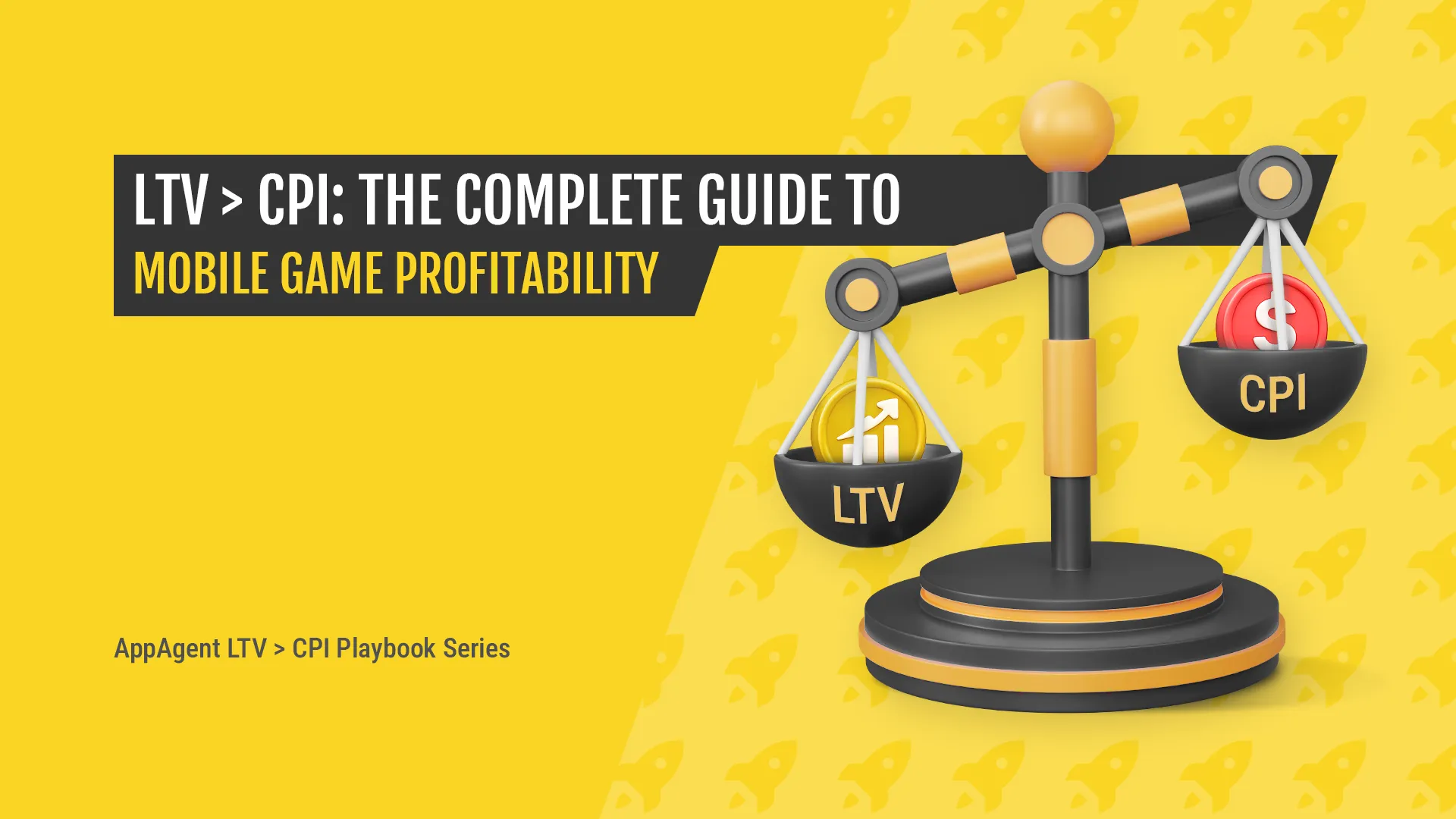
Everything in this mobile marketing guide serves bending that inequality in your favor. It is the lens that separates effective marketing that scales from marketing that just spends.
The Mobile Gaming Market in 2026: Bigger, Pricier, Harder to Win
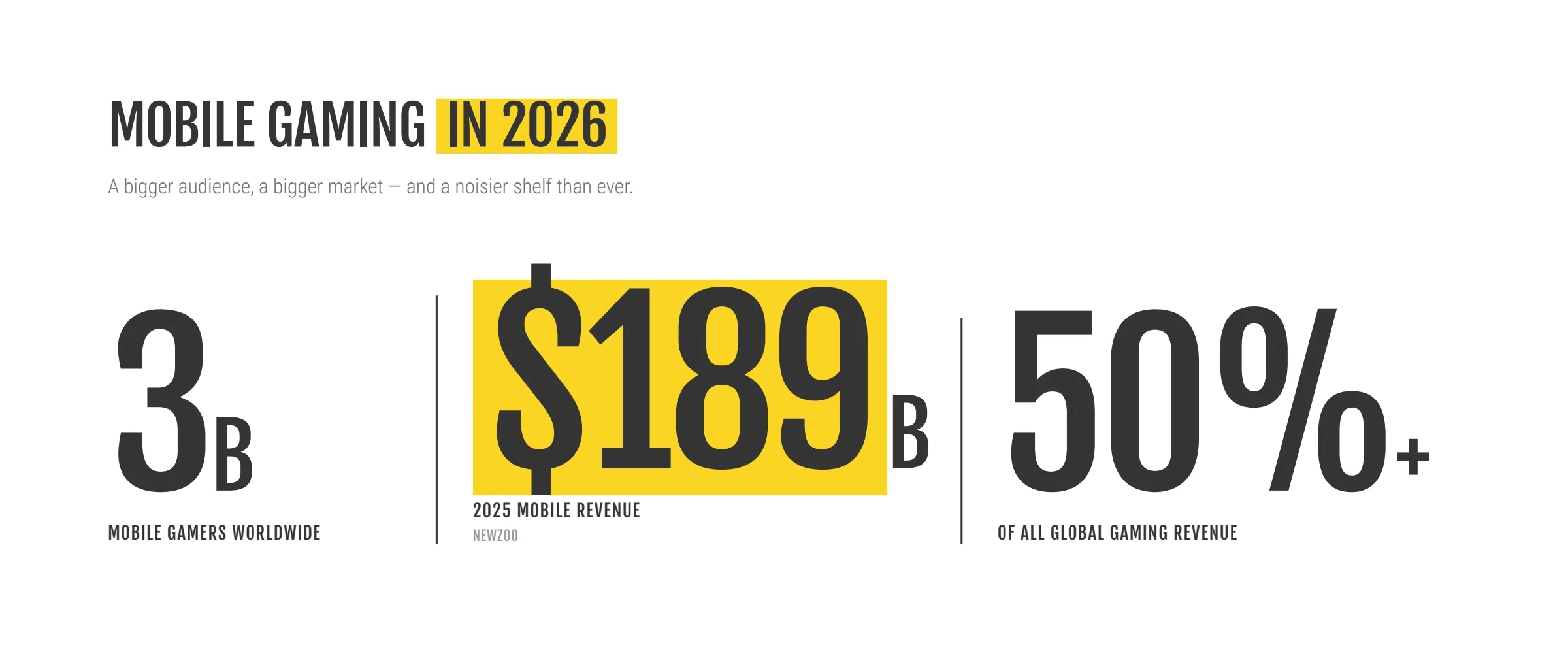
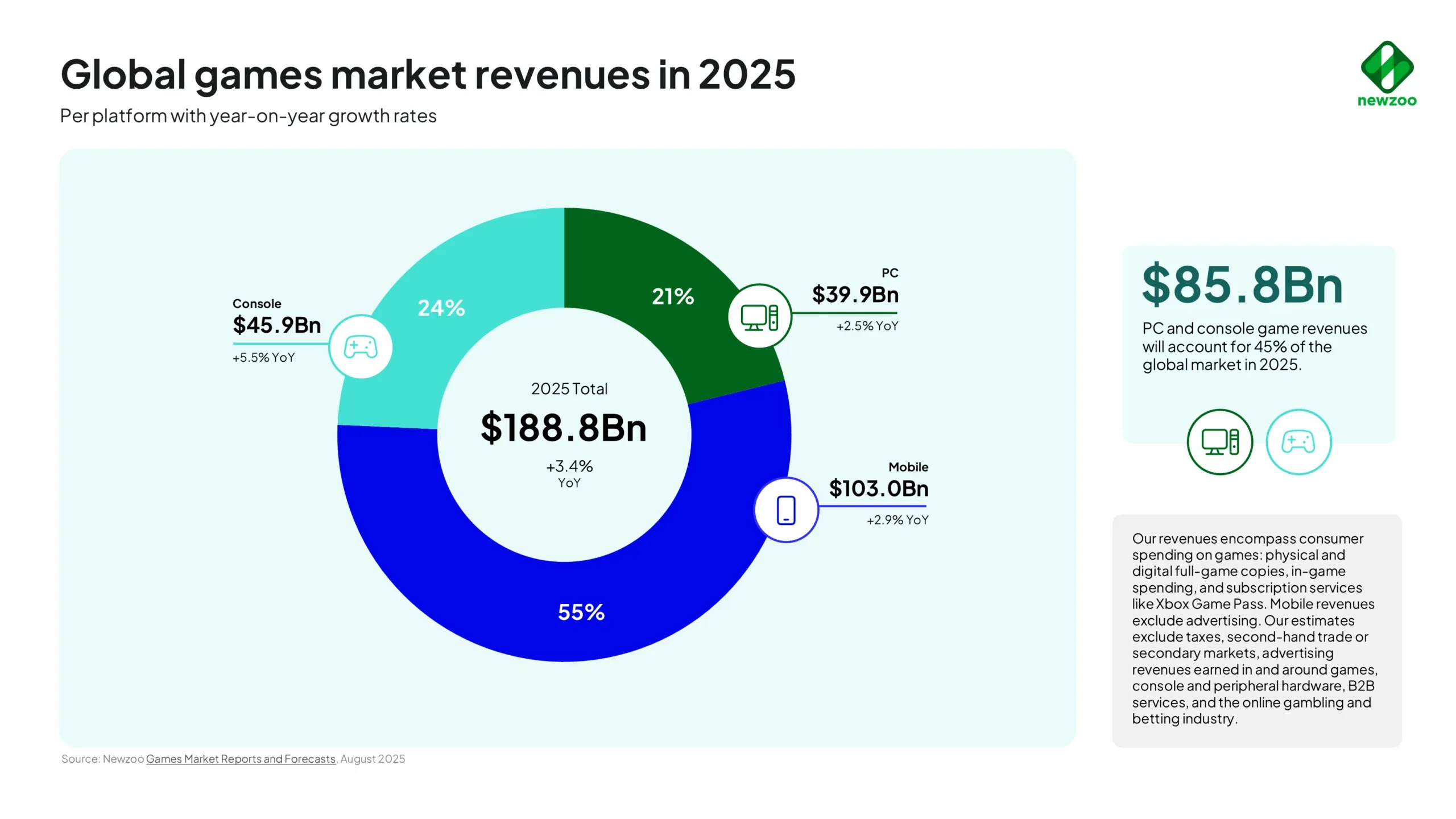
The opportunity has never been larger, and neither has the noise. Roughly 3 billion people play mobile games, and the segment now generates over half of all global gaming revenue – $189 billion in 2025, according to Newzoo.
But tens of thousands of fresh titles reach the App Store and Google Play every month, which means discoverability, not craftsmanship, is the real bottleneck. A polished title with no marketing system is invisible, no matter how talented the studio. And the work begins earlier than most teams expect.
For any mobile game developer, marketing of the game starts long before launch day, during the build itself, when you still have time to shape positioning, test creative concepts, and warm up a day-one audience. A successful mobile game is rarely an accident of quality. It is the product of a plan that ran in parallel with development.
Key Trends in Mobile Game Marketing
A few shifts have rewritten the playbook of performance marketing in the mobile games industry, and ignoring them is expensive. Cost per install keeps climbing, squeezing already thin margins.
Privacy-first attribution, driven by Apple’s SKAD framework, has made the clean one-to-one tracking marketers relied on largely a thing of the past. Creative wears out faster than ever, forcing studios to rotate a living library rather than lean on one tired ad.
The deepest change is the quietest. The big platforms have handed targeting, bidding, and budgeting to their own machine learning, and Meta’s Andromeda and Advantage+ systems have effectively ended manual optimization.
AI now floods feeds with more content than anyone can watch, so the bar for a concept that breaks through keeps rising. One number captures the stakes: in gaming, Appsflyer’s data shows the top 2% of creatives drive 53% of ad spend. A tiny number of winners carry everything.
That is exactly why your approach has to be integrated and measured as a whole, not run channel by channel on gut feel, and why the targeting job has moved from the media buyer to the creative.
The Four Pillars of an Effective Mobile Game Marketing Strategy
The strongest mobile game marketing strategies rest on four interdependent pillars: paid advertising, organic growth, ASO, community / content / influencer work, and data analytics. Most teams treat these as separate departments with separate budgets, and that is precisely where money leaks.
They are not separate workstreams. Creative learnings from paid testing should feed your store page; retention data should shape how you bid; measurement governs the whole system and tells you which lever to pull next.
We map this into a single diagnostic with 17 distinct levers across acquisition, creative, ASO, retention, monetization, and virality, because the levers interact, and a studio bleeding cash on UA often has its real problem three pillars away.
That full framework is laid out in our LTV > CPI guide. Throughout, keep the LTV:CAC ratio in view. That ratio, not raw install volume, is what tells you whether any of this is working.
Pillar 1: Paid User Acquisition
Paid traffic is the primary way to promote a mobile gaming app, but it only turns a profit when the creative and the measurement underneath it are sound. The channel rarely decides whether you win. It’s the creative! Treat paid acquisition as a delivery system for great ads and expanding your target audience through diverse messaging around your mobile game app.
Video Ads
The dominant format is the short clip, usually 15 to 30 seconds (short on social networks such as Meta & TikTok, long on rewarded networks such as Applovin and Unity Ads), built around either a burst of exciting gameplay or a “fail” scenario that makes the viewer itch to play it better themselves. A few seconds of motion communicate a core loop faster than any description.
The single most important part of that clip is the first three seconds. Meta’s delivery system disproportionately judges whether two ads are “the same” based on the hook, so the opening frames do double duty: they hook the human, and they tell the algorithm what kind of ad this is and who to show it to.
Aim your hook at a specific persona immediately, and vary your hook styles deliberately across immediate action, result-and-rewind, a secret or reveal, a story, a bold statement, a hopeless-until-solution arc.
Playable Ads
Playable creatives let a person try a slice of the game before they install. That “try before you buy” mechanic filters for genuine intent, so the players who do install tend to stick around longer.
The format keeps gaining ground, and interactive, quiz-style mechanics are now outperforming single-tap ads, with 82% of new playables leading with a few seconds of video before handing over the controls. The way to find your best one is to pair your winning video hook against several playable bodies and let the data pick the combination.
We go deeper in our dedicated guide to the state of playable ads.
Rewarded Ads
In the rewarded format, players earn in-game currency in return for watching an ad inside another app. It sits at the volume end of the spectrum and works well for re-engagement and cheap top-of-funnel reach.
The trade-off is intent: someone who watched to collect coins elsewhere is less primed to commit than someone who chose to try a playable. However, if there’s one strong trend I noticed at MAU Vegas this spring, it’s a massive growth of rewarded video ad networks, with Applovin crushing everyone measured by performance and revenues.
Choosing Channels and Why Creative Wins
The main paid channels in 2026 are Meta, Google, Ads TikTok, AppLovin, and Apple Search Ads, and each plays a different role rather than being interchangeable, which is why an ad that wins on TikTok often falls flat when you lift it straight onto AppLovin.
We treat Meta as the validation and scaling engine, Unity and AppLovin as cheap, fast signal for game mechanics and playables, TikTok as the place to discover hooks and emotional angles, and Google Ads as late-stage reach for proven concepts. Our channel-by-channel creative playbook covers how to adapt a concept to each surface.
Spreading across them also manages real risk: when a recent Meta delivery disruption sent campaign metrics sharply down across accounts, studios running a single channel had no baseline to tell a platform problem from a campaign one.
But channel selection is the smaller half of the story, and it is shrinking. Here is the part that changes how you should staff and budget your whole UA operation.
On Meta, Andromeda builds a shortlist of potentially relevant ads before the ranking system decides what shows in a feed. If your ad never makes that shortlist, it cannot win the auction, no matter how good it is. Your creative portfolio’s entire job is to get onto that shortlist as often as possible, across as many contexts as possible.
The trap is that Meta groups similar ads into what it calls Entity IDs, and it decides “similar” far more aggressively than teams expect. In one example Meta shared from its own workshops, an advertiser built 12 ads with six genuinely different scripts, but all 12 used the same creator in the same living room, so the system collapsed them into two or three Entity IDs and most starved. After the fix, three creators, four settings, and a mix of formats, the same 12 ads became nine or ten distinct Entity IDs. Retrieval rose three to four times and cost per acquisition dropped 28 percent. The scripts never changed. Visual diversity did.
That single result contains the most important creative lesson of 2026: visual similarity overrides thematic difference. So the rule we give clients is blunt. Stop making variations and start making concepts. A variation is the same ad with a new headline or end card. A concept is a different angle, format, hook, or persona, something a viewer would register as a different ad. When you find a winner, do not iterate by copying the template. Take the principle that worked and rebuild it in new worlds.
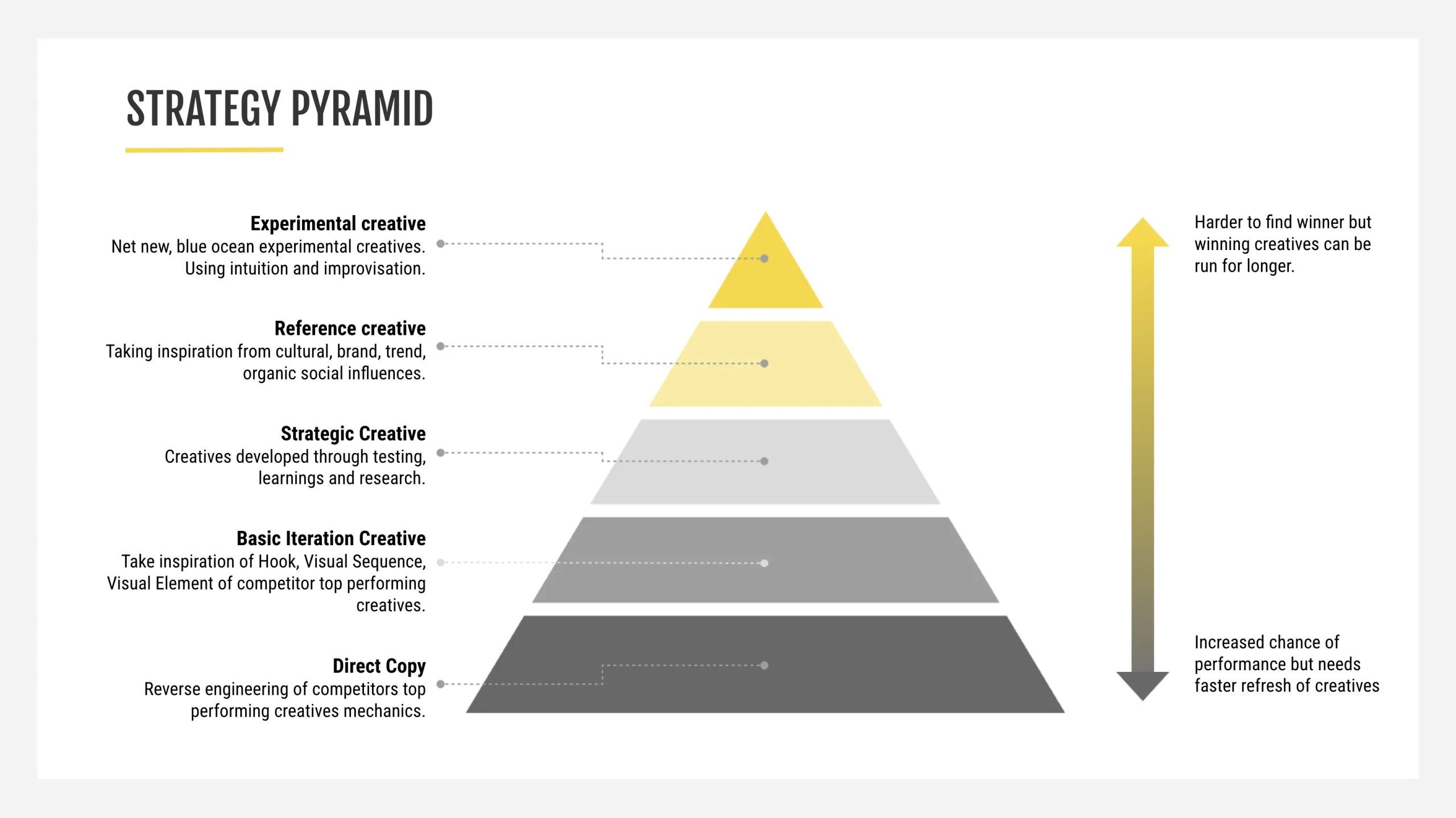
Sustaining that diversity without descending into noise is where most teams break, and it is why we run two named systems rather than improvising. The first is the Creative Strategy Pyramid, which sorts every idea into five rising levels: Direct Copy (lift a competitor’s proven mechanic, quick but short-lived), Basic Iteration (tweak one element such as a headline or visual), Strategic Creative (original ideas built from research and testing), Reference Creative (drawing from culture, trends, and social insight rather than other games), and Experimental Creative (bold new concepts that mostly fail but occasionally open a blue ocean). Direct copies fatigue fastest, because everyone is copying the same thing and players tire of the sameness; in fact copycat creatives often stop scaling within seven days. Durable performance lives higher up the pyramid.
The second system is how we test, a three-stage pipeline of Sandbox, Challenger, and Scale. Sandbox is a pure attention filter: drop 10 to 20 new concepts, judge them only on hook, hold, and click-through in the first 24 hours, and kill the bottom 70 to 80 percent before they touch your main campaigns. Challenger pits surviving themes against each other to see which motivation deserves budget. Scale validates that the winners hold up under real auctions.
One contrarian note that saves real money: we test serious concepts in Tier-1 markets, not cheap Tier-3 ones. A creative that “wins” in Brazil can mis-train Andromeda for US buyers, producing a false positive that dies the moment you scale it, and a fake winner costs you twice.
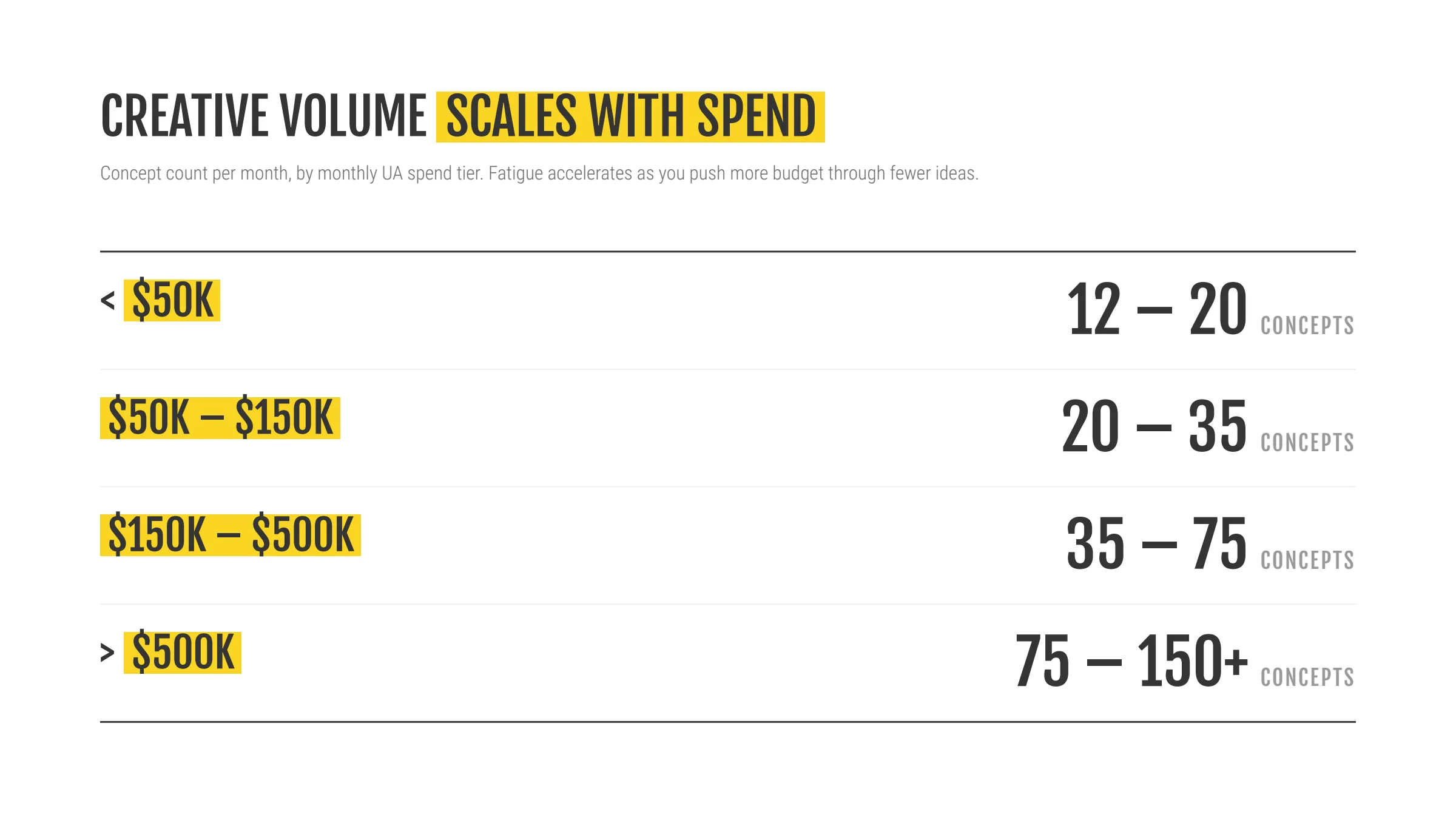
How much creative does this take? It scales with spend, because fatigue accelerates as you push more budget through fewer concepts. Under $50K a month, plan for 12 to 20 distinct concepts per campaign with a few new ones every two weeks. Between $50K and $150K, 20 to 35 refreshed weekly. Between $150K and $500K, 35 to 75 with 6 to 10 new ones weekly. Above $500K, 75 to 150-plus concepts and daily iteration on winners, because at that scale concepts fatigue inside 7 to 14 days. This is the reality behind AppAgent’s Creative Program, where human strategists own the concepts and the hooks and AI handles competitor deconstruction and variant production fast enough to keep the grid full.
Pillar 2: Organic Growth and App Store Optimization (ASO)
One hundred percent of your installs, paid and organic, pass through the store page, which makes it the single highest-leverage surface you own. Treat ASO not as a one-time keyword checklist but as a permanent conversion system that makes every paid click more efficient, because traffic you already paid for still has to say yes when it arrives.
ASO has two main parts: visibility in app store search (by using primarily keywords and optimising metadata of your app store listing) and conversion rate optimization. Mobile gamers rarely search for games in stores so it’s mobile ads that drive most of downloads. Active promotion of your game is therefore a necessity, no marketing team should rely on organics at the current level of market saturation.
Keywords and Metadata
Optimizing your title, subtitle, and description with the terms real players type improves your visibility in store search. The two platforms behave differently: the App Store leans on a dedicated keyword field and weights the title heavily, while Google Play reads your full long description. Map your metadata to each on its own terms rather than copying identical text across both.
The payoff can be large and fast: for Star Stable’s iOS launch, disciplined metadata, keyword, and localization work moved the game from rank 4 to rank 1 for “horse” and related terms, and delivered 54 percent higher iOS conversion alongside 50 percent more store traffic.
One lever most teams overlook sits one level up from keywords: your category. It does not change your keyword index directly, but it decides which charts, filters, and recommendation pools you compete in, so for a multi-genre title, choosing a category where you can realistically rank near the top beats sitting permanently behind a few giants.
Store Visuals and Creative Assets
Your icon, screenshots, and preview video turn a curious visitor into an install, and they deserve the same rigor as your paid ads. Test variations rather than trusting taste, and keep your store creatives visually aligned with the ads in your campaigns. When the promise a player saw in a clip matches what greets them on the page, conversion climbs; when they disagree, you pay for a tap and lose it at the doorstep.
The discipline is hypothesis-driven, not cosmetic. For Clash Royale we did not swap colors and hope; we defined three distinct hypotheses for why players might convert better, tested them, and found a role-playing-themed variant won. Swapping a background is a variation but testing a reason is a true experiment.
Treat conversion rate optimization as an ongoing program, and one tip changes what you optimize toward: on Google Play, the native A/B test lets you target either first-time installers or retained first-time installers. Choose the second.
Winning an install that churns the next day is a hollow victory; optimizing for the player who stays raises the quality of everyone the store sends you and lifts LTV, not just install count. Every install you win through a better page instead of more spend is margin you keep.
If you are budgeting this, our breakdown of what ASO costs is a useful start, and a GamePlan™ diagnostic maps where the highest-return opportunities sit before you commit to any scope.
Pillar 3: Community, Content, and Influencer Marketing
Paid and organic acquire players. Community, content, and creators build durable demand and keep those players around. This is the pillar that compounds, lowering your blended cost of acquisition over time, because an audience that already trusts your title is far cheaper to convert than a cold one.
Start with creators, and resist chasing the biggest follower counts. Engagement and genuine fit with your genre matter more than raw reach, and the best results come from partners whose audiences already gather where games live. Around that, content marketing does the slow work of building familiarity, and the user-generated content it produces doubles as raw material for your next round of creative testing. What resonates with your community usually tells you what your next winning ad should say.
Then there is the half that decides your economics: retention. In-game events, seasonal content, and well-timed re-engagement bring lapsed players back at a fraction of the cost of acquiring someone new, and the data backs prioritizing it.
For mid-core games, Appsflyer found that social motivators like community and competition are severely underused in creative yet deliver the highest day-7 retention of any motivation, around 24.5 percent. Royal Match is the textbook execution: it builds social hooks in early, from gifting lives to team tournaments where you compete as a group, and that layer drives both higher participation and higher retention than a standard event.
All of it connects to lifetime value. A game that retains will out-earn a game that merely acquires, every time.
Pillar 4: Data, Metrics, and Measurement
Measurement is what turns the other three pillars into a profitable whole. Without it you are guessing with a bigger budget. A reliable Mobile Measurement Partner (MMP) and a clear metric framework are the floor you build everything else on.
The Metrics That Matter
A few numbers carry most of the weight. CPI is worth decomposing, because CPI equals CPM divided by IPM, which means a rising CPI is either a market problem (CPM, the cost of reaching people) or a creative problem (IPM, installs per thousand impressions). Watching the two separately tells you which one to fix. LTV is meaningless without a timeframe, so always speak of LTV at a specific day. ROAS is simply LTV over CPI.
Retention at day 1, day 7, and day 30 is the earliest honest signal of whether your game has legs; as a rough health check, above 40 percent on D1, 20 percent on D7, and 10 percent on D30 means you are in decent shape. Read together, these tell a growth team not just what is happening but why.
The Golden Rule: LTV > CPI (and Why LTV:CAC Is the Real Target)
A game is profitable when the lifetime value of a player exceeds the cost to acquire them. The cleaner way to run a program is to watch the payback period, the day your accumulated LTV finally crosses your CPI. Shorter paybacks let you reinvest without raising outside money; long ones make you dependent on large up-front cash and are dangerous to scale.
Payback varies sharply by genre: roughly 2 to 7 days for hyper-casual, 1 to 6 months for hybrid-casual, and 6 months to 2 years for mid-core and hardcore.
Once you internalize this, raw install volume is exposed for what it is. In growth audits we repeatedly see studios chase cheap CPI campaigns to hit DAU or other vanity targets, and it is one of the most expensive habits in the business, because a million installs that never pay you back is not growth.
As Roberto puts it, margin is the silent killer: it is not enough to get LTV above CPI, you need enough margin left to sustain the business. For the cash-flow side, see our piece on the CAC payback period.
Measuring in a Privacy-First World
Apple’s SKAN framework and the post-IDFA shift replaced deterministic, user-level tracking with aggregated, delayed, partial signals, which makes incrementality testing far more valuable: instead of asking which click gets credit, you ask whether your spend truly caused installs that would not have happened otherwise.
This is also the hidden reason creative-as-targeting works. Platforms match your creative to the right target audience using on-platform engagement, what people watch and interact with, which survives privacy restrictions precisely because it never depended on third-party tracking. You target with the creative now, and who that creative attracts is itself part of LTV.
How to Build a Mobile Game Marketing Plan
A real growth plan is less a document than a sequence: the order in which a studio should build and spend so the plan does not collapse halfway through a launch. The single most common mistake is starting too late. The thinking has to begin during development, because the earliest choices about audience and positioning shape everything downstream. Building a game and building its growth engine are the same project, on the same calendar, and they rest on a few foundational enablers we cover in how mobile games scale profitably.
Start With Audience and Market Research
Research is not a box-ticking exercise, it is a CPI lever you pull before a single ad exists.
When we supported the fitness game Walking Planet in soft launch, we ran more than 1,000 in-game surveys and 20 one-to-one interviews, which surfaced three distinct clusters of players. We chose to target the broadest, least demanding one and rebuilt the messaging and creatives around it. The newly tuned ads came in at half the CPI of the earlier campaigns, with higher retention on top.
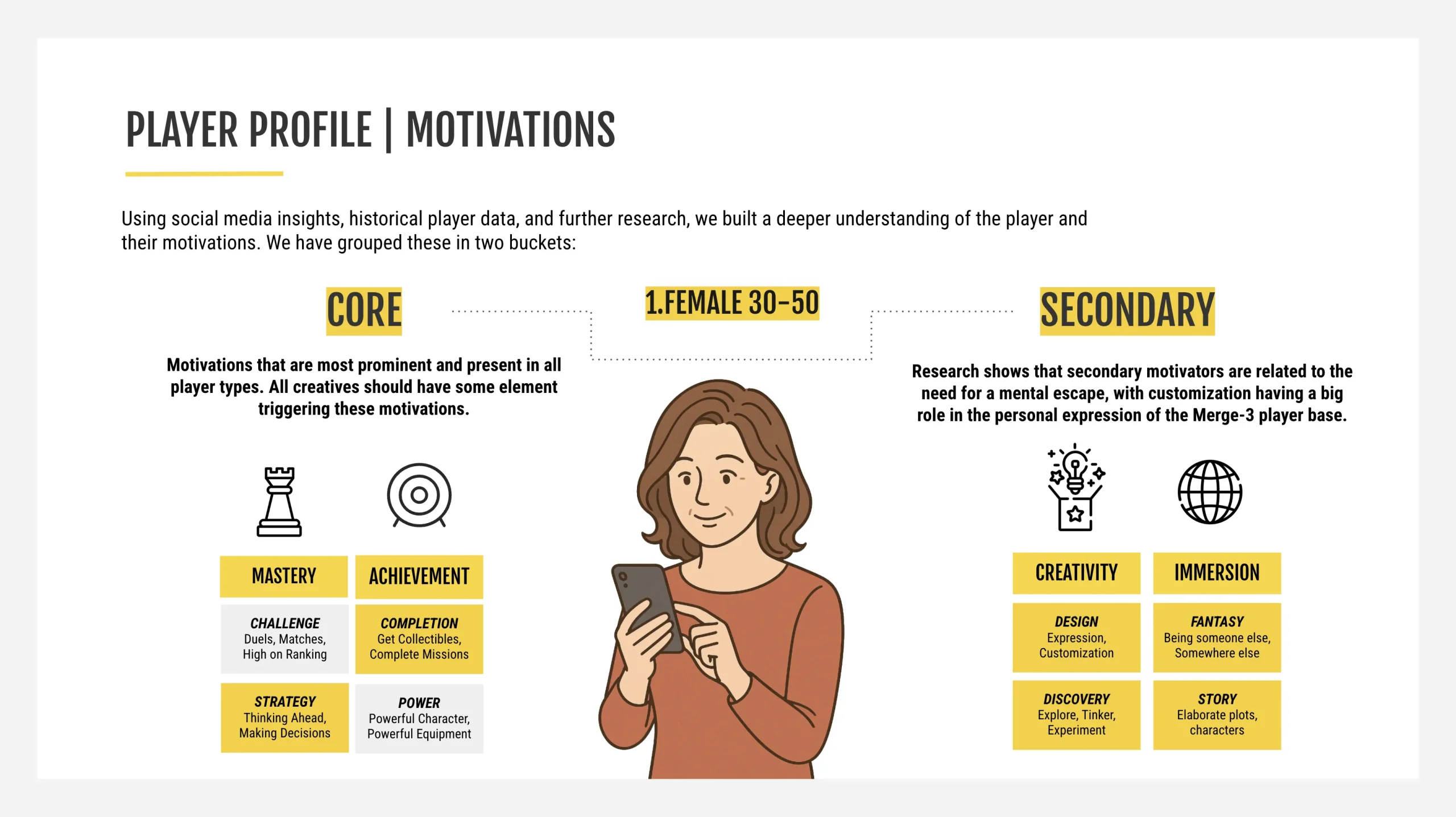
That gap did not come from a better media buy. It came from knowing exactly who to talk to.
Soft Launch, Test, and Validate
A soft launch in one or two markets lets you pressure-test the things that decide profitability, CPI, early retention, and initial ROAS, before you expose your game to your most valuable regions.
You can validate even earlier with a marketability test, using paid campaigns to evaluate a concept before the game is built. For Innogames and Sunrise Village, we tested which theme would resonate most, crime and mystery, love and romance, or magic and sci-fi, by building tuned creatives and store assets for each and reading top-of-funnel signals to find the consistent winner.
The data you gather here turns the eventual scale-up into a calculated move rather than a leap of faith.
Sequence Paid and Organic Together
With validation in hand, phase your budget deliberately, moving from a learning phase into scale only once the numbers justify it. Run paid and organic in concert so insights flow both directions: the creative that wins in your ads informs your store page, and the search terms that convert organically inform your paid keywords. If you are weighing in-house versus help, our overviews of user acquisition management costs and mobile game marketing agency pricing lay out the trade-offs.
Running Your First Mobile Game Marketing Campaign
Think about your campaign across the whole lifecycle of the game, because the work is continuous rather than a single launch-week sprint. The studios that win think in loops, not launch dates.
In the pre-launch window, stand up a landing page and a complete store page, begin early creative testing so you enter launch with proven concepts, seed a community for day one, and start outreach to press and creators. Patience here pays.
When we brought the fashion game Bellemint to market with Muus Collective, the soft launch was built on precision over speed, skipping cheap installs in favor of creative experimentation and player value, and it returned a 29 percent lift in day-7 retention and a 45 percent increase in ROAS.
When launch arrives, concentrate spend into a focused push that drives ranking velocity, leaning on the assets you already validated.
Then comes the longest and most important phase: post-launch live-ops. Here you refresh creative constantly, because most concepts fatigue within roughly 7 to 14 days, which is why our testing cadence runs on a weekly rhythm with fast 48-hour kill decisions rather than one-time drops. You run retention campaigns, ship seasonal events, and feed every result back into the next decision.
Starborne Frontiers shows the loop in motion: translating a PC-depth strategy game to mobile took relentless creative iteration and a significant shift in communication style, and that produced a 14 percent creative win rate and a meaningful ROAS lift.
The strongest marketing campaign is really a loop, where each outcome sharpens the move that follows it.
Build Your Mobile Game Marketing Strategy with AppAgent
If there is one idea every game marketer should carry out of this guide, it is that profitable growth comes from spending on the right things, in the right order, at the right stage of your game’s life. That is what AppAgent was built to deliver, which is why the work starts with senior strategy rather than a generic menu of services.
AppAgent is an award-winning growth and creative agency focused entirely on mobile games. The team has supported more than 150 mobile games for publishers including Supercell, Netflix Games, Scopely, Plarium, and 505 Games. The roster is kept deliberately small so senior people stay involved on every account, and the agency keeps real skin in the game by building and investing in its own titles.
The engagement maps cleanly onto the four pillars. GamePlan™ is the strategic diagnostic that identifies the highest-return opportunities across acquisition, ASO, creative, and monetization before any money is spent. The Growth Program delivers managed UA, ASO, data, and product execution in focused three-month sprints. The Creative Program handles creative strategy and production across 2D, 3D, UGC, and live-action, built for the volume-and-diversity reality that Andromeda now demands.
The results speak plainly. For DreamLoft’s Game of Words, AppAgent helped drive a 65 percent revenue surge in four months, sustained a 33 percent creative win rate, and kept the title profitable on paid acquisition for more than three years running.
On Marvel Puzzle Quest with 505 Games, a GamePlan engagement surfaced 79 distinct growth opportunities and contributed to a 101 percent year-over-year lift in day-7 ROAS on Android.
For Pixel Federation’s Puzzle Adventure, a Brand GamePlan™ marketability test validated a full rebrand. The boldest direction, “Seoul Secrets,” delivered a 38 percent increase in iOS IPM and a 20 percent decrease in Android CPI, plus a surprise lift in early retention, all without touching the core game (yet, the team at Pixel Federation then refocused on Trainstation 3 which proved to be economically more perspective).
If your installs have plateaued, your costs keep climbing, or you simply want a clear read on where your next dollar should go, book a strategy call with AppAgent at https://appagent.com/contact/. We work with game studios and game publishers who are ready to invest north of $150K into marketing efforts over a year and look for a strategic partner to grow their game user base and revenue.